Text Tools
 Image Tools
 PDF Tools
 Social Media Tools
 Security Tools
 Coding Tools
 CSS Tools
 Color Tools
 Miscellaneous Tools
 Add to Chrome
 Add to Firefox


Enter or scan your 5x5 cube and follow the full solution on a 3D cube: centres, edges, then as a 3x3.
Hold the cube with the white centre on top and the green centre facing you. Pick a colour (keys 1 to 6), then tap or drag over the squares. The side faces are as you see them when you turn the cube left; the top with the front at the bottom, the bottom with the front at the top.
Front side, as it faces you.
144 squares have no colour yet.
What the 5x5 Rubik's Cube Solver does
A 5x5 cube, the Professor's Cube, has 150 coloured squares and a number of positions that takes 75 digits to write down. The 5x5 Rubik's Cube Solver takes whichever of those positions your cube is in and gives you the moves that bring it back to six plain sides, about 170 of them, worked out in under a second.
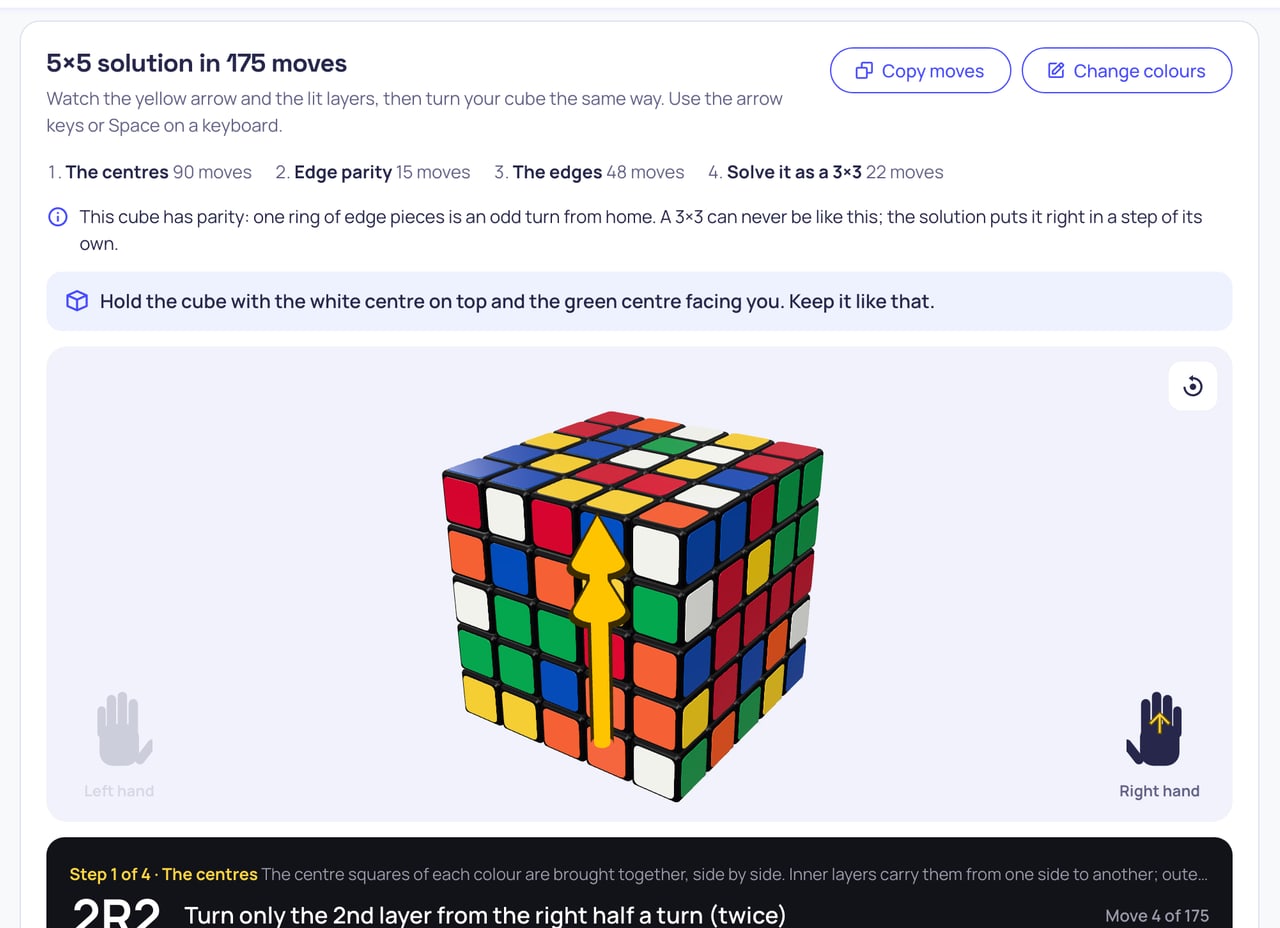
Reading 170 letters off a screen would be hopeless, so the solution is played on a 3D model of your cube instead. For every move the layers that turn are lit, an arrow points the way, and a sentence says what to do: "Turn the middle layer, between top and bottom, to the left". You press Next move when your cube matches the picture. If you lose your place, step back, or click any earlier move to return to it. The solver is free and works in the browser of a phone, tablet or computer.
Getting the colours in
A 5x5 has one thing a 4x4 lacks: a fixed centre in the middle of every side. Those six squares never change places, so they tell you how to hold the cube. Put the white centre on top and the green centre toward you, and leave it like that. If your cube has a logo on one centre, that square still counts as its colour.
Enter colours shows the six sides with their centres already filled in. Choose a colour and tap or drag across the squares that have it. Dragging matters on a 5x5: a row of three or four squares of one colour is painted in one stroke. On a phone you work through the sides one by one on a large grid, and the small pictures above it turn from grey to coloured as you go. Each colour is used 25 times, and its counter shows how many are still missing.
Camera reads a side when you hold it inside the frame: because of the fixed centre, the solver recognises which side it is looking at and takes the picture when the image is steady. Scramble accepts a move list such as Rw U2 Fw' D 3R B' Uw L2, which is the fastest way if you mixed the cube from a timer.
Before you solve, look at the 3D preview and turn it with your finger or mouse. If it looks like the cube in your hand from every side, you are ready.
How to solve a 5x5 cube: what the solver does, stage by stage
The solver follows the reduction method, the same idea used on a 4x4 and taught in every 5x5 tutorial: make the big cube behave like a small one. The list above the 3D cube shows how many moves each stage takes for your scramble.
The centres: 48 squares that can move
Around each fixed centre sit eight more centre squares. Four touch its sides and four touch its corners, and the two kinds never mix: a square from a corner place can only ever go to a corner place. So the solver has two rings of 24 squares to sort, and it brings each square to the side whose fixed centre has its colour. Early on, one turn of an inner layer can drop three squares into place at once. Toward the end, when five sides are done, single squares are exchanged between the last sides with short sequences that put everything else back. This is the longest stage, around 80 moves.
The edges: three pieces each
Every edge of a 5x5 is a row of three: a middle piece, as on a 3x3, with a wing on either side. The middle pieces decide what each edge should be, and the 24 wings are brought to them. A wing is slid next to its middle piece by turning one inner layer, the edge is taken out of that layer, and the layer is turned back. One such move can complete two edges at once. Count on 55 to 60 moves.
The rest: a 3x3 in disguise
With nine-square centres and three-piece edges, turning only the outer layers moves the cube exactly like a 3x3. The solver ends with about 20 outer turns. If you can solve a 3x3 yourself, this is a good place to take over: the cube in your hands is now a familiar puzzle, only bigger.
5x5 parity: one kind only
People coming from the 4x4 expect two parity problems. The 5x5 has one. Two whole edges can never be swapped on a 5x5, because the middle edge pieces and the fixed centres hold the edges and corners together just as they do on a 3x3.
What can happen is this: all edges are paired except the last one, whose two wings are in each other's place, and no ordinary pairing move is left to swap them. Whether your cube will end like that is decided by the scramble, and it is true for about half of them. The solver works it out from the wings as soon as the centres are finished, and when it applies it plays one 15-move sequence at once: 2R2 B2 U2 2L U2 2R′ U2 2R U2 F2 2R F2 2L′ B2 2R2. After that the pairing goes through to the last edge without trouble. The step is listed as Edge parity, and a note above the cube tells you your scramble had it.
The notation on a 5x5
Five layers in each direction need names. Counting from the right: R is the outer layer, 2R the one next to it, and 3R the middle layer, which on a 3x3 would be called M. Rw turns the outer two together and 3Rw the outer three. The same goes for L, U, D, F and B, each counted from its own side. A following ′ means anticlockwise as seen from that side, a 2 means half a turn.
The solutions use single inner layers such as 2R more often than wide turns. When you turn one, hold the layers on both sides of it still with your other hand, and check your cube against the 3D cube before going on: turning two layers where one was meant is the most common slip on a 5x5.
Mistakes the solver catches before you start
Entering 144 squares by hand rarely goes right the first time, and the Solve button stays off until the cube is possible. What is wrong is said in a sentence and outlined in red. The solver counts 25 squares of each colour. It checks the eight corners and the twelve middle edges exactly as on a 3x3, including a twisted corner, a flipped edge and two swapped pieces. It checks the wings: no wing has two opposite colours, and no two wings show the same colours the same way round. And it checks the two rings of centre squares: each ring must hold four squares of every colour, so a white square entered on a corner place when it belongs on a side place is found even though the total of whites is right.
FAQ
How many moves does a 5x5 take?
About 170 here: roughly 80 for the centres, 55 to 60 for the edges, 20 for the 3x3 stage, and 15 more when the cube has edge parity.
Can I pause and come back later?
The colours you entered are kept in your browser, so the cube is still there when you return. Solve again and click the move you had reached.
I made a wrong turn. What now?
If you notice at once, undo your turn and carry on. If you are not sure when it happened, press Change colours, correct the map to match your cube as it is now, and solve again from there.
Does it matter that my centres have another colour arrangement?
Almost every 5x5 has white opposite yellow, green opposite blue and red opposite orange. If yours is like that with other colours, use each colour of the solver for one of yours.
Is there a solver for smaller cubes?
Yes: the 4x4 solver, the 3x3 Rubik's Cube Solver and the 2x2 solver. The Rubik's Cube Timer times your solves.