Text Tools
 Image Tools
 PDF Tools
 Social Media Tools
 Security Tools
 Coding Tools
 CSS Tools
 Color Tools
 Miscellaneous Tools
 Add to Chrome
 Add to Firefox


Five red lights, then lights out: your F1 start reaction time, and where it puts you on the grid.
Into Turn 1
Make a start and watch it on a grid of 20 cars: the others react like a Formula 1 field, and you see how many places your reaction wins or loses.
Last five starts
How quick is that?
Formula 1 drivers get away about 0.2 seconds after lights out. Most people answer a light in about 0.27. Under 0.1 nobody reacts: that is a guess, and counts as a jump start here.
Your record
What is the F1 Reaction Test?
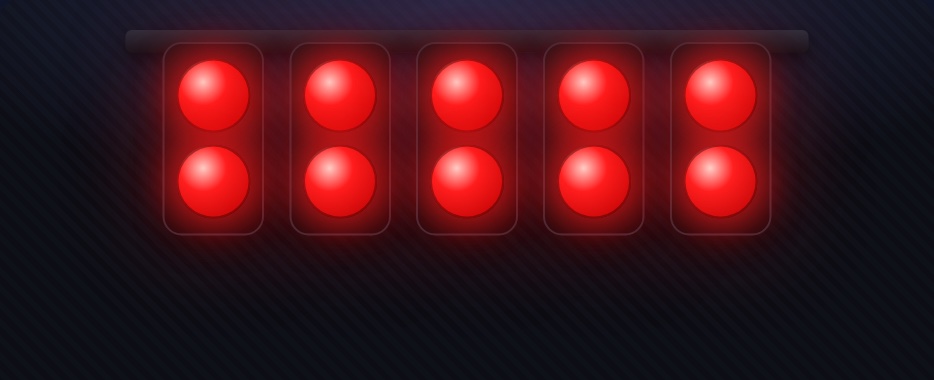
The F1 Reaction Test puts you on the grid of a Grand Prix. Five pairs of red lights come on, one a second. They stay lit for a random moment, then all go out at once, and the time between lights out and your tap is your reaction time, shown in thousandths of a second as on a Formula 1 timing screen. Move while the lights are still on and it is a jump start. Each start is then replayed on a grid of 20 cars, so you see how many places that reaction would win or lose on the run to Turn 1.
How the start lights work
The test follows the real start procedure. The five lights come on at one-second intervals. Once all five are lit there is a wait of between 0.2 and 3 seconds, chosen at random each time, so the moment cannot be counted out or guessed. Then every light goes out together: that is the start. Formula 1 drivers get away about 0.2 seconds after lights out.
Three ways to play
- Practice: one start after another, with your last five times, their average and their spread. Turn on Quick lights and the reds come on faster, for many starts in a row.
- Grand Prix: five starts make one result. The average of five says more than one lucky start; your best average is kept on your device.
- 2 Players: one screen, one set of lights. Each player has half the screen (or the A and L keys), and the first off the line takes the round. First to three wins. A jump start hands the round to the other player.
What makes it different
- Into Turn 1: after every start, a view from above shows the grid getting away. The other 19 drivers react like a Formula 1 field, and you see whether you held your place, gained or lost. Choose any grid slot from pole to P20.
- Honest timing: the clock starts on the frame the lights go out and stops on the time stamp of your tap, not when the page gets round to it. Your screen's refresh rate is shown, because every frame it draws adds a little to any time.
- No guessing: nobody reacts to a light in under a tenth of a second, so a time below that counts as a jump start.
- Any input: tap, click, Space or Enter, or any button of a controller or racing wheel.
- A picture to share: save your time as an image, or send a challenge link that shows your time as the one to beat.
- Your record: best start, best Grand Prix average, number of starts and jump starts, and a chart of your last 30 times, kept in your browser.
How to take the F1 Reaction Test
- Tap the lights, click them or press Space to line up.
- Watch the five red lights come on. Keep still: moving now is a jump start.
- The moment all the lights go out, tap, click or press Space.
- Read your time, then look at Into Turn 1 to see what it did on the grid.
- Choose Grand Prix for a five-start average, or 2 Players to race a friend on the same screen.
Frequently asked questions
What is a good F1 reaction time?
On this test, under 0.215 seconds is Formula 1 pace and under 0.250 is quick. Most people answer a light in about 0.27 seconds. Anything from 0.29 to 0.35 is a normal start; above 0.45 you would be swamped by the cars behind. Remember that a phone or a monitor adds its own delay, often 20 to 50 thousandths, which a racing car's start system does not have.
How fast do F1 drivers react at the start?
About 0.2 seconds from lights out to the car moving. That is close to the limit of what people can do: reactions to a light much below 0.15 seconds are not reactions at all but anticipation. Drivers train for it, and they also have the easier job of releasing a paddle they are already holding rather than pressing something.
Why did I get a jump start?
You tapped while the lights were still on, or less than a tenth of a second after they went out, which is too quick to have been a reaction. The wait after the fifth light is random, from 0.2 to 3 seconds, so trying to time it does not work: wait for the dark.
How many places can a reaction win or lose?
Fewer than you might think, and that is realistic. Grid slots are 8 metres apart and a car covers about 100 metres in the first four and a half seconds, so a tenth of a second is worth four or five metres: half a grid slot. A start two tenths slower than the car behind usually costs one place; a stall costs several. The view after each start shows exactly this.
Why is my time slower on my phone?
Every device adds delay between the lights going out in the program and the picture changing, and between your finger and the program. A 60 Hz screen draws a new picture every 17 thousandths of a second; touch screens and wireless mice add more. Times are best compared on the same device. A screen with a higher refresh rate and a wired mouse or keyboard give the lowest numbers.
Is anything saved or sent?
Your record is kept in your own browser so it is there next time, and Reset clears it. Nothing is uploaded and there is no account.
About this tool
F1 Reaction Test by 10015.io is a fan-made reaction game. It is not affiliated with or endorsed by Formula 1, the FIA or any team. For a plain test of reflexes to a colour or a sound, with an aim trainer, see the Reaction Time Test.