Text Tools
 Image Tools
 PDF Tools
 Social Media Tools
 Security Tools
 Coding Tools
 CSS Tools
 Color Tools
 Miscellaneous Tools
 Add to Chrome
 Add to Firefox

A WPM test that shows the maths behind your score, a three-round speed profile and a WPM calculator.
What is this WPM Test?
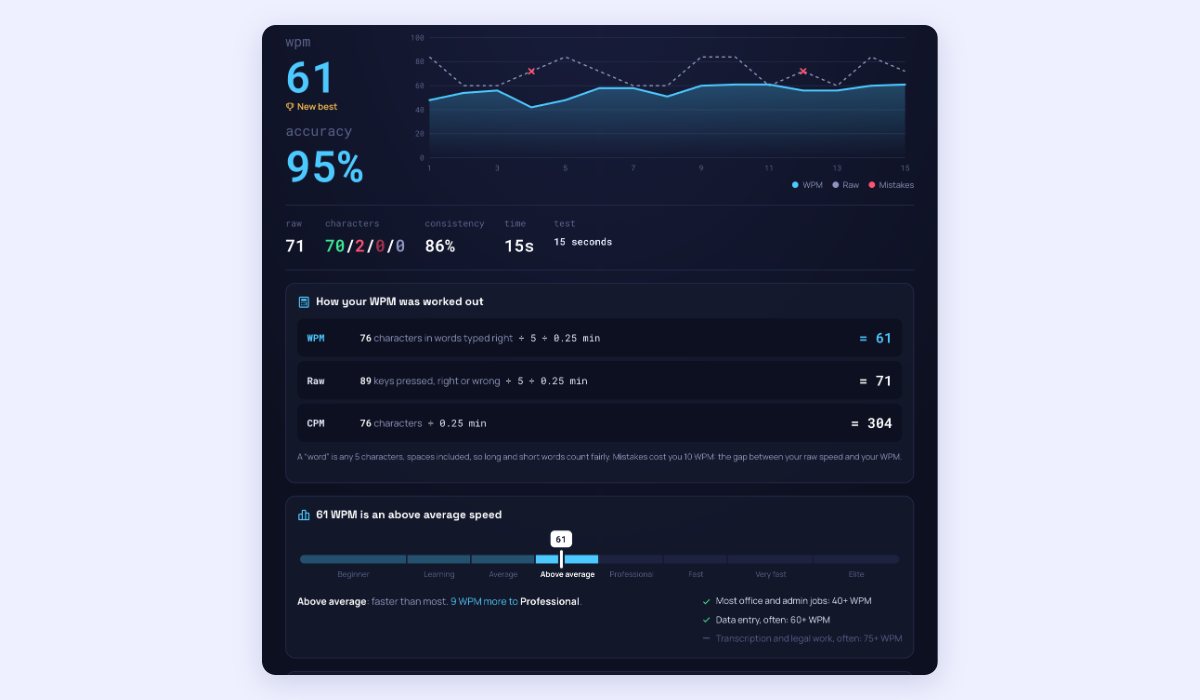
A wpm test measures how many words per minute you type. Most tests give you one number and stop there. This one shows the sum behind it with your own figures, places your speed on a scale from beginner to elite, and ranks it among 168,000 typists from a university study. The speed profile goes further: three short rounds of plain words, real sentences, and numbers and symbols show where your speed goes and what to practise. And the calculator works out WPM for a test you took on paper or somewhere else.
Three ways to use it
- WPM test: 15 seconds, 30 seconds, 1 minute or 2 minutes of words, with punctuation, numbers, harder words or another language if you want them.
- Speed profile: a 15-second sprint, 30 seconds of real sentences and 30 seconds of numbers and symbols. You get your everyday speed and where you lose it.
- Calculator: enter the words or characters you typed, the time and your errors, or paste the text, for gross WPM, net WPM, accuracy and CPM. It also converts WPM to CPM, keystrokes per hour and more.
How to use the WPM Test
- Choose a WPM test, the speed profile or the calculator.
- Start typing the words: the clock starts with your first key.
- Fix mistakes as you go: words left wrong do not count.
- See your WPM, how it was worked out, where it stands and how you rank, then try again or share it.
How is WPM calculated?
A “word” is any five characters, spaces included, so a test with long words and one with short words are scored the same way. WPM is the characters in the words you typed right, divided by five, divided by the minutes. Raw WPM, also called gross WPM, counts every key you pressed, right or wrong. The gap between the two is what your mistakes cost you. Job tests often use net WPM instead: gross WPM less one word a minute for every error left in.
What is a good WPM?
In a 2018 study by Aalto University and the University of Cambridge, 168,000 people averaged 52 WPM. About 40 WPM is enough for most office work, and data entry and transcription jobs often ask for 60 to 75 WPM. Above 85 WPM puts you among the fastest tenth of typists, and competitive typists go past 120 WPM.
Frequently asked questions
What is the difference between WPM and CPM?
CPM is characters per minute. Since a word counts as five characters, CPM is WPM times five: 60 WPM is 300 CPM. The calculator converts between WPM, CPM, characters per second, keystrokes per hour and words per hour.
Why is my speed lower on real sentences?
Capitals need the Shift key, and punctuation and numbers sit away from the home row, so nearly everyone slows down on real text. The speed profile measures how much, so you know whether to practise those keys. For lessons, try Typing Practice.
How long should a WPM test be?
One minute is the usual length and a fair measure. Fifteen seconds shows your top speed, and longer tests show how well you hold it: for a job test, practise with the 5 Minute Typing Test.
Is my data sent anywhere?
No. Everything runs in your browser, and your results and history stay there. For more ways to test, try the Typing Test or get a typing certificate.