Text Tools
 Image Tools
 PDF Tools
 Social Media Tools
 Security Tools
 Coding Tools
 CSS Tools
 Color Tools
 Miscellaneous Tools
 Add to Chrome
 Add to Firefox


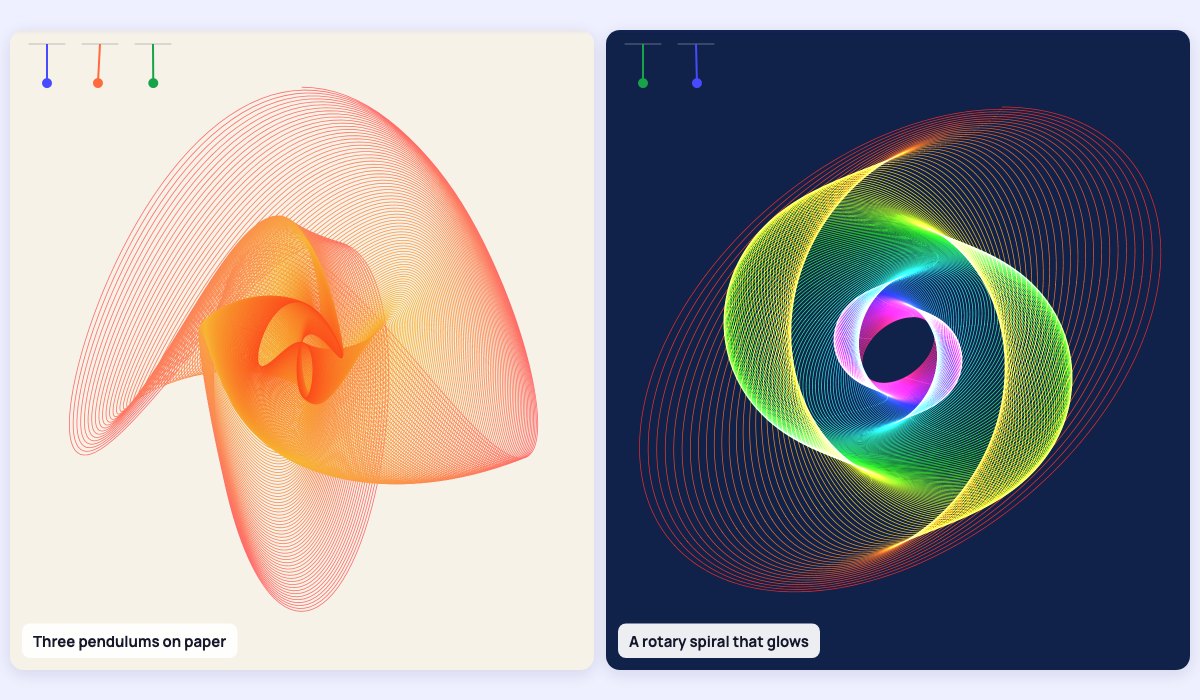
Pendulums swing a pen across paper and draw spirals and roses as they slowly die away. Tune them, watch it draw and save the art.
Frequencies in simple ratios such as 2:3 make closed figures; nudging one a little out of tune (2 : 3.006) makes them turn slowly as they shrink, which is where a harmonograph’s beauty comes from.
What is a Harmonograph?
A harmonograph is a Victorian drawing machine: pendulums swing a pen and the paper against each other, and as they slowly lose their swing the pen traces looping spirals, roses and woven figures no hand could draw. This one does it on screen: set up to four pendulums, choose how fast each swings, where it starts and how quickly it dies away, and watch the drawing grow line by line. When it is finished, save it as a PNG up to 4096 pixels, as an SVG for a plotter or a poster, or as a video of it being drawn.
What it can do
- Up to four pendulums, each swinging the pen side to side or to and fro, or turning the paper in circles as a rotary pendulum.
- Every setting: frequency to a thousandth, phase, swing and friction, with how long each pendulum would be on a real machine whose first pendulum is a metre long.
- Watch it draw, with the pen and the pendulums swinging in the corner, at up to 80 times real time, or draw it all at once.
- Colour: any ink or a gradient along the line, on paper, white, dark or transparent, with a line that fades as the swing dies and a glow on dark paper.
- 10 variations from the classic 2:3 to a rotary spiral, a four-pendulum weave and a ribbon of light, and Surprise me for a new one every time.
- Save it as a PNG of 1080, 2048 or 4096 pixels, a vector SVG, a video, or a link that draws it again.
How to use it
- It starts drawing at once. Pause it, start it again, or draw it all at once with the buttons under the drawing.
- Change a pendulum’s frequency, phase, swing or friction, and the drawing starts again from the beginning.
- Add a pendulum, up to four, or remove one; switch it between side to side, to and fro and rotary.
- Pick a variation, or press Surprise me, then change the paper and colours under Look.
- Save the finished drawing as a picture or an SVG, or record a video of it being drawn.
How a harmonograph works
Each pendulum swings back and forth like a sine wave, and friction makes each swing a little smaller than the last. The pen’s position across the paper is the sum of the pendulums that move it that way, x(t) = A·sin(2π·f·t + φ)·e−d·t, and the same for the other direction. Two pendulums at right angles draw a Lissajous figure; because both are dying away, the figure shrinks towards the middle as it goes round, and the lines lie side by side instead of on top of each other.
The magic is in the ratio of the frequencies. Simple ratios such as 1:2, 2:3 or 3:4 make figures that close on themselves; nudge one frequency slightly out of tune, to 2 : 3.006, and the figure turns a little on every round, weaving the shimmering bands harmonographs are famous for. A rotary pendulum, which turns the paper in a small circle, adds spirals. A pendulum’s frequency depends only on its length: one swinging once a second is about 25 cm long, and halving the frequency means four times the length.
Ideas to try
- Detune slowly: start from 2 and 3 and move the second to 3.001, 3.003, 3.01, and watch the weave open up.
- Less friction fills the paper with fine lines; more gives a few bold loops.
- Swap the phase of one pendulum from 0° to 90°: a line becomes a circle.
- Glow on dark paper with a gradient makes it look like a long-exposure photograph of light.
- Print it: save the SVG and plot it with a pen plotter, or print the 4096-pixel PNG as a poster.
Frequently asked questions
Is this harmonograph free?
Yes. There is nothing to sign up for or install, it runs entirely in your browser, and the pictures and SVGs you save are yours to use, print or sell.
Who invented the harmonograph?
It grew out of Jules Antoine Lissajous’s experiments with vibrating tuning forks in the 1850s, and the Scottish mathematician Hugh Blackburn built an early pendulum version. By the 1870s harmonographs were a popular wonder at scientific lectures and in Victorian drawing rooms, and many people still build them from wood today.
Is it like a real harmonograph?
It uses the same mathematics, with each pendulum swinging as a damped sine wave, which is how a real one behaves while its swings stay small. A wooden machine also wobbles a little and its friction is not quite even, which gives its drawings a slightly freer line; turning on fading and a touch of detuning brings that feel back. For a spirograph's gears instead of pendulums, try the Spirograph, and for real pendulums, the Pendulum Simulator.