Text Tools
 Image Tools
 PDF Tools
 Social Media Tools
 Security Tools
 Coding Tools
 CSS Tools
 Color Tools
 Miscellaneous Tools
 Add to Chrome
 Add to Firefox


Make your own word groups puzzle: hide linked words in a grid, order them by difficulty and share one link.
Grid
4 groups of 4: 16 words on the board. Put the easiest group first and the hardest last; the order sets the colours.
Groups
Details
What is Word Groups Maker?
Word Groups Maker lets you make your own word grouping puzzle: a grid of words that secretly belong to a few groups, and the player has to find what links them. You write the groups, press Create the link and send it on. Whoever opens it gets the words shuffled on a grid, picks four they think belong together and presses Submit. Find every group before the mistakes run out and you win.
If you have been looking for a way to make a custom Connections puzzle for friends, this is that kind of game with its own design and a few more options: 3, 4 or 5 groups, 3, 4 or 5 words in each, your own order of difficulty, and a choice of how many mistakes are allowed. It runs in the browser on any phone or computer, with no app and no account. It is an independent game by 10015.io and is not affiliated with or endorsed by The New York Times.
How to make a word groups puzzle
- Set the grid: how many groups (3, 4 or 5) and how many words in each group (3, 4 or 5). Four groups of four gives the classic sixteen-word board.
- For each group, type what links them in What links them? (for example "Card games") and fill in the words.
- Put the groups in order of difficulty with the Easier and Harder arrows. They are labelled from Easiest to Hardest (and Fiendish for a fifth group), and each level has its own colour: blue, orange, red, purple and green.
- Prefer typing? Paste a list takes one group a line, the name then a colon:
Card games: snap, poker, bridge, rummy. Handy if you wrote the puzzle in a notes app first. - Add a title ("Friday quiz, week 12"), your name under Made by, and choose the mistakes allowed: 3, 4, 5 or no limit.
- Press Create the link. Copy it, send it through your phone's share sheet or WhatsApp, show the QR code, or press Try it to play it yourself.
The maker checks the puzzle as you go: every group needs a name and every box a word, and if the same word appears twice it tells you, since a word can only belong to one group. Your draft stays in the browser until you come back to it, and Play a sample shows a finished puzzle if you want to feel how it plays first.
How the game is played
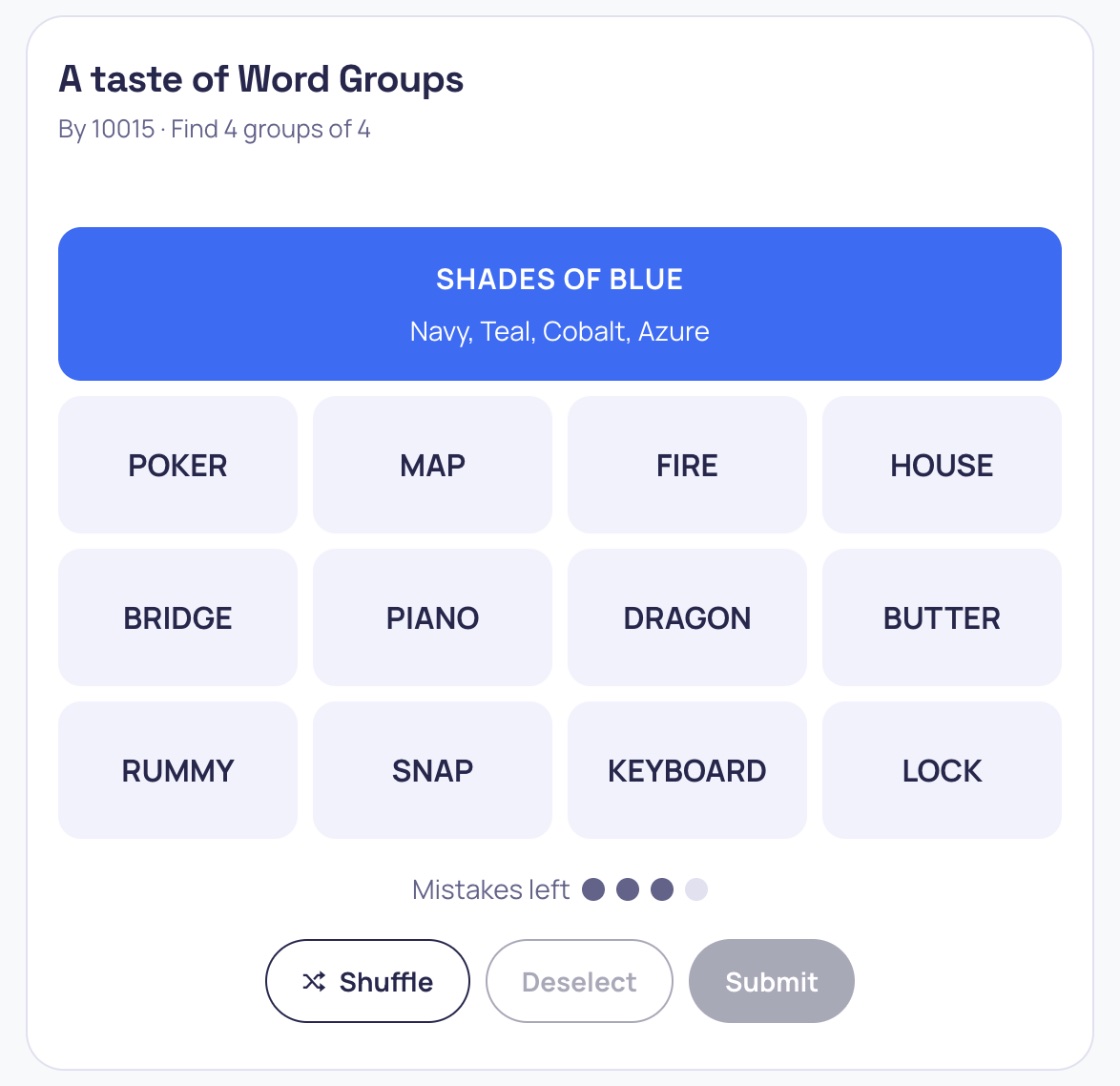
The words arrive shuffled. Tap to select a group's worth, then press Submit. A right guess turns those words into a coloured band with the group's name; a wrong one costs a mistake, and if all but one of your words belong together you see One away…. Shuffle rearranges the board when your eyes start seeing the same false pattern, and Deselect clears your choice. At the end, every group is revealed and Share result copies your guesses as rows of coloured squares, without giving the words away. Progress is saved, so a player can come back to a half-finished grid.
Ideas for your own puzzle
- A Friday office quiz: colleagues' pets, meeting-room names, things the boss always says, and a group of words that hide a coffee order.
- The classroom: a teacher's vocabulary set sorted by meaning (synonyms of "big"), by word class, or by topic, such as planets, rivers, capital cities. Three groups of three is a gentle start for younger pupils.
- Birthdays and family: the places you have lived, the names of the old dogs, films you watched together, and a group only the birthday girl will spot.
- Fans and hobbies: players, albums, characters or recipes, for a club, a Discord server or the pub team.
How to write a good word grouping puzzle
Choose categories of different kinds
A good grid mixes the obvious with the sly. Start with one plain category (Shades of blue: navy, teal, cobalt, azure), add one that needs general knowledge (Card games), then a wordplay group such as words before or after a hidden word (___fly: butter, dragon, fire, house), and finish with a lateral one (They have keys: piano, map, lock, keyboard). Four groups of the same kind feel like a list; four kinds feel like a puzzle.
Plant red herrings
The best puzzles have words that look as if they fit two groups. In the example above, teal is a colour and also a duck, and house could sit with the ___fly words or tempt someone into a group of things with keys. If you have a group of fish, slip in bass among musical words, or sole near a group of shoe parts. A red herring works when exactly one group can take the word; check that each word only truly fits its own group, or players will rightly feel cheated.
Order the difficulty
Put the easiest group first and the trickiest last with the arrows, so the colours tell players afterwards which one was meant to hurt. Leave at least one group that can be found early: a solved band shrinks the board and makes the rest easier to see. Then press Try it and solve it yourself as a stranger would. If you find a fifth group by accident, change a word.
Name the link clearly
The group name is the reveal, so make it satisfying and exact: "Things with keys" rather than "Misc", "___fly" rather than "Insects-ish".
Frequently asked questions
How do I make my own word groups puzzle?
To make a puzzle like NYT Connections for your friends, choose the grid size, type a name and the words for each group, order them by difficulty and press Create the link. Send the link and your friends play your puzzle straight away, free and without signing up.
Does it have to be four groups of four?
No. You can have 3, 4 or 5 groups with 3, 4 or 5 words each, from a quick nine-word grid to a twenty-five-word monster.
Can players see the answers in the link?
No. The whole puzzle travels inside the link after the # sign, scrambled so the groups cannot be read off the address bar. Nothing is stored on a server, so the link keeps working.
Can I use it in a classroom?
Yes. Pupils need no accounts: show the QR code on the board or post the link. Set "No limit" on mistakes if you want everyone to reach the end, and use smaller grids for younger children.
Can I use phrases or numbers instead of single words?
Yes. Each box takes short text, so names, phrases, numbers or emoji all work, as long as no item appears twice in the grid.
Is this the New York Times game?
No. Word Groups Maker is an independent word grouping game with its own design and options. It is not connected to The New York Times or its games.