Text Tools
 Image Tools
 PDF Tools
 Social Media Tools
 Security Tools
 Coding Tools
 CSS Tools
 Color Tools
 Miscellaneous Tools
 Add to Chrome
 Add to Firefox

Sing low, then high: see your vocal range on a piano, your likely voice type and song keys that suit you.
Find your vocal range
Two short steps: slide down to your lowest comfortable note, then up to your highest. Hold each note for a moment so it counts. Everything is analysed on this device; no audio is recorded or uploaded.
- Use a quiet room and keep the microphone about an arm's length away.
- Headphones help if you use the reference notes.
- Warm up first, and never push into pain or strain.
What is Vocal Range Test?
Vocal Range Test measures the notes you can sing, from the lowest to the highest, using your microphone and the browser alone. You slide down to your lowest comfortable note, then up to your highest, and the test turns your voice into notes on a piano keyboard as you sing. At the end you get your vocal range in note names and hertz, how many octaves it covers, which voice type it overlaps most, how it compares with well-known singers, and which key to sing a song in.
It is free, needs no account and no audio leaves your device: the pitch is worked out in the page itself, frame by frame, and nothing is recorded or uploaded. If you would rather not use a microphone, a by-ear mode lets you find the same notes by playing them on a keyboard and singing along.
How to test your vocal range
- Press Start the test and allow the microphone. Stay quiet for a second while the background noise is measured, then check that the level bar moves when you speak.
- Step 1, lowest note. Start on a comfortable note in the middle of your voice and slide down slowly on an "ah". When you reach the bottom, hold the lowest note you can sing clearly for about half a second. A note only counts once it has stayed within half a semitone for 0.3 seconds, and a tick appears on the keyboard when it does.
- Step 2, highest note. Slide up as high as you can sing cleanly and hold the top note. If your voice flips into falsetto or head voice, press the falsetto button so those notes are kept apart.
- Press See my range. Play your lowest and highest notes back on the piano to check them, and adjust where your voice changed register if you need to.
Stuck? Play a lower note and Play a higher note sound a piano tone one semitone beyond your current limit, so you can copy it. Headphones stop the piano from reaching the microphone, although the test ignores the microphone while a reference note is playing anyway.
What your result shows
Your lowest and highest notes are written in scientific pitch notation, where C4 is middle C and each octave starts on C: A2 is the A below the C below middle C, and A4 is the 440 Hz tuning note. Next to each note is its frequency. The span is given in semitones and octaves; twelve semitones make one octave.
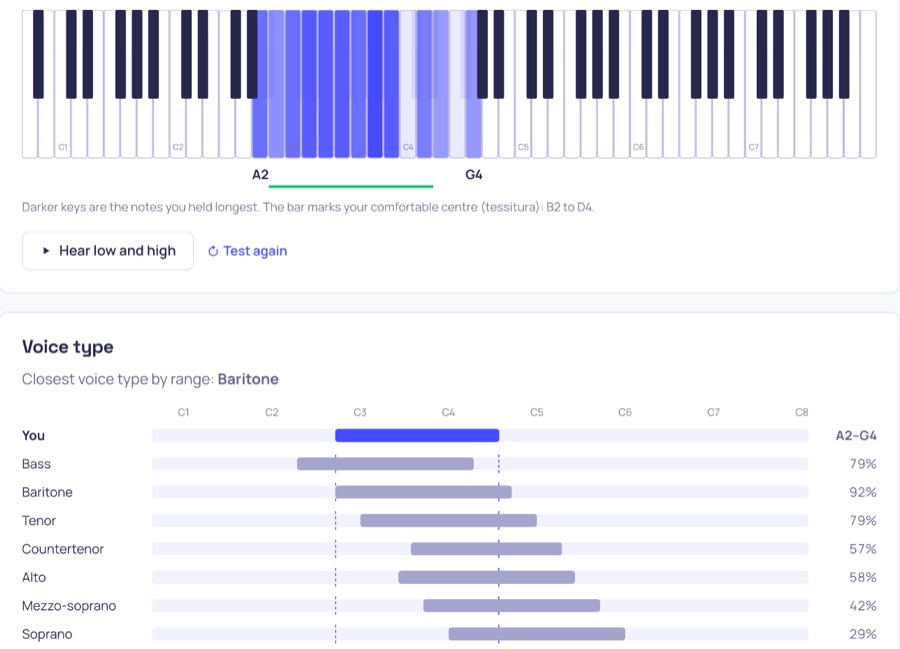
The keyboard heat map colours all 88 piano keys by how long you held each note during the test. The darker keys are where your voice spends its time, and the green bar underneath marks your tessitura: the stretch of notes that holds the middle 80% of your singing. Range tells you what you can reach; tessitura tells you where you are comfortable, and it is the better guide for choosing songs.
If you marked a register change, the result shows two ranges: your chest range (full voice) and your full range including falsetto. This matters more than it seems. A baritone can often float a falsetto up to a soprano's high notes, and a test that only looks at the top note would call him a soprano. Here the voice type is judged on the chest range.
Vocal range chart: the voice types
Classical singing sorts voices into types by range, weight and colour. The ranges below are the typical ones used by teachers and choirs; trained singers often go a few notes beyond them, and the result page shows how much of each one you covered.
- Bass: E2 to E4, the lowest male voice.
- Baritone: A2 to A4, the most common male voice.
- Tenor: C3 to C5, the highest usual male chest voice.
- Countertenor: G3 to E5, a male voice singing mostly in head voice or falsetto.
- Alto (contralto): F3 to F5, the lowest female voice.
- Mezzo-soprano: A3 to A5, the middle female voice.
- Soprano: C4 to C6, the highest female voice.
Each type spans roughly two octaves, and they overlap a lot: a G3 is a comfortable note for a baritone, a tenor, an alto and a mezzo alike. That is why the range alone cannot settle a voice type, and why the test reports a percentage for every type rather than a single verdict.
Am I a tenor or a baritone?
It is the most asked voice type question, and the honest answer is that range is only the first clue. A baritone usually sits comfortably around A2 to E4 and starts to strain above F4; a tenor's voice feels at home higher, around D3 to G4, and can carry full voice up to A4 or beyond with training. If your lowest notes are strong and your top notes in chest voice are around F4, you are probably a baritone. If the bottom of your range thins out around C3 but you can ring out G4 and A4, tenor is more likely.
Teachers listen for the timbre (dark and full or bright and light), for where the voice sounds its best, and for the passaggio, the notes where the voice changes gear. A baritone's passaggio is usually around B3 to E4, a tenor's around D4 to G4. Mark your register change in the test and compare it with these: it is often more telling than the top note.
Soprano, mezzo or alto: female vocal ranges
The same logic holds for women. A soprano range centres around C4 to C6 and the voice feels easy high in the staff; a mezzo-soprano covers about A3 to A5 with a richer middle; an alto range runs about F3 to F5 and is strongest low, often with a chest voice that can reach down to E3 or D3. Many untrained women read as altos at first simply because head voice has not been practised. If your range grows quickly at the top as you warm up, keep an open mind.
How the pitch is measured
The test reads the microphone in frames of 2048 samples (about 40 milliseconds) with echo cancellation, noise suppression and automatic gain turned off, because those filters distort a singing voice. Each frame is checked for loudness against the noise floor measured at the start, then analysed with the McLeod pitch method, which finds the repeating period of the waveform and how clean it is. Frames that are too quiet or not clearly pitched (a breath, a consonant, a cough) are ignored, and frequencies are kept between 60 and 1600 Hz, which covers any human singing voice outside whistle register.
A frequency is turned into a note with the standard formula, where A4 = 440 Hz. A note is only counted after you have held it for 0.3 seconds within 50 cents (half a semitone) of its centre, using the median of the readings, so a single crack or slide does not set your range. On synthesised test tones the detector is accurate to a few cents across the whole singing range, without octave errors.
Find the right key for a song
Under Find a song key that fits, enter the lowest and highest notes of a melody. The test suggests how many semitones to move it up or down so that the whole song fits inside your range with its middle on your comfortable notes, then plays the new lowest and highest notes so you can try them. Most karaoke apps, music players and capo charts accept a transposition in semitones, so you can use the number directly. If a song spans more notes than your range, the test tells you how many will stay out of reach and centres the rest where you are strongest.
Compare yourself with famous singers
The singer comparison lays your range next to the ranges commonly quoted for well-known artists, on the same keyboard. Take those figures lightly: they are fan and press estimates that often include a single studio note or whistle register, not careful measurements. What they show well is scale: most popular songs use little more than an octave and a half, and a two-octave range is already plenty for most music.
Tips for an accurate singing range test
- Warm up first. Five minutes of humming and lip trills can add several notes at both ends.
- Count only usable notes. A creaky growl at the bottom or a squeak at the top is not part of your singing range. If you could not hold it for a phrase, leave it out.
- Use a quiet room and keep the microphone about an arm's length away, so it neither misses quiet low notes nor overloads on loud high ones.
- Test at a different time of day. Voices are lower and stiffer in the morning. Your past results are kept in this browser, with a small chart, so you can watch your range grow as you practise.
- Never push into pain. Range grows with technique, not force.
Frequently asked questions
What is a good vocal range?
Most untrained adults have a range of about one and a half to two octaves. Trained singers commonly reach two and a half to three octaves, and anything beyond three and a half is unusual. A wider range is not automatically better: control and tone across the notes you use matter far more.
What is my vocal range if I cannot use a microphone?
Choose Find it by ear. Tap keys on the piano to hear them, sing each one back, and mark the lowest and highest you can match comfortably. The result works the same way, apart from the heat map of held notes.
Is my voice recorded or uploaded?
No. The pitch is calculated in your browser while you sing and nothing is stored except the notes of your results, which stay in this browser on this device.
Why does the test not pick up my lowest notes?
Very low notes are quiet and many laptop and phone microphones barely pick them up. Move closer to the microphone, sing a little louder, and use an open vowel such as "ah". A noisy room also raises the threshold a note has to pass.
Can my vocal range change?
Yes. Regular practice with good technique usually extends the range by a few notes, mostly at the top, and makes the existing notes easier. Illness, tiredness and age lower it for a while. Teenage voices, boys' especially, change a lot during puberty.
Does the test tell me my voice type for sure?
No test based on range alone can. It shows which voice type your notes overlap most, which is a useful starting point. A voice teacher or choir director will also listen to your timbre, your register changes and where your voice sounds its best before naming a voice type.