Text Tools
 Image Tools
 PDF Tools
 Social Media Tools
 Security Tools
 Coding Tools
 CSS Tools
 Color Tools
 Miscellaneous Tools
 Add to Chrome
 Add to Firefox

The planets where they really are on any date, at any speed, in 2D or 3D, and what-ifs worked out by gravity.
The real Solar System
What if…
What is Solar System Simulator?
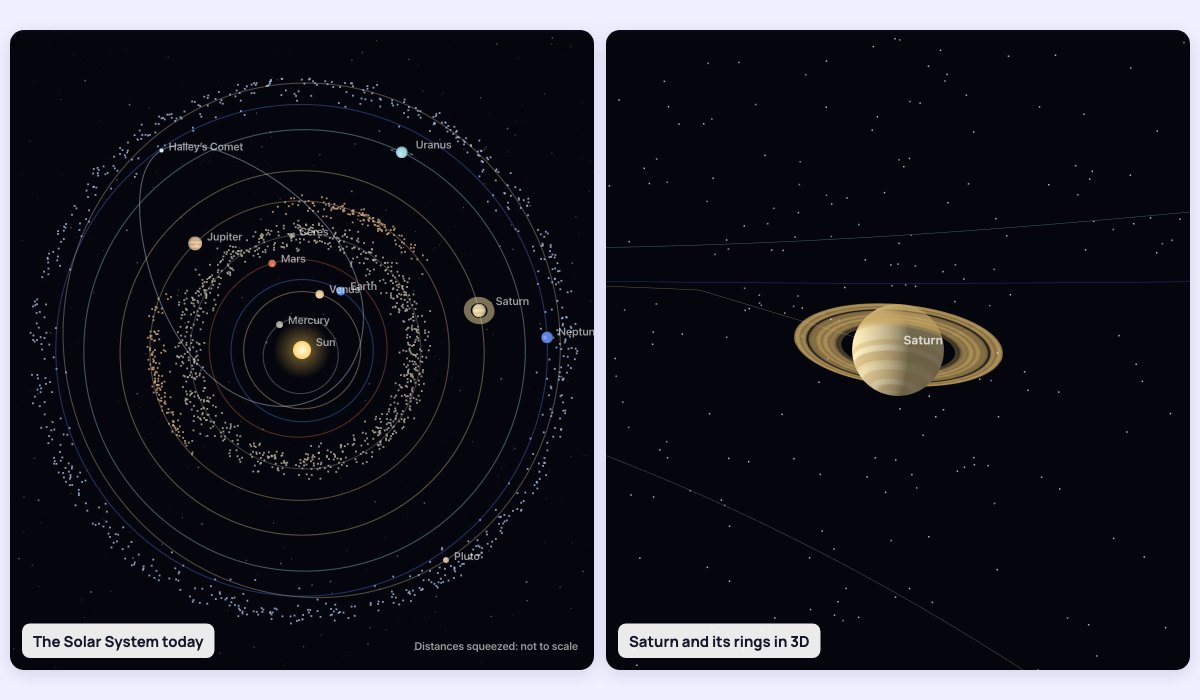
Solar System Simulator shows the Sun, the eight planets, the Moon, Ceres, Pluto and Halley’s Comet where they really are on any date from the year 1000 to 3000, and sets them moving at any speed, from real time to a century a second, forwards or backwards. It is an orrery in your browser, built on the orbital elements NASA’s Jet Propulsion Laboratory publishes, with the asteroid belt, Jupiter’s Trojans and the Kuiper belt, in a flat view from above or in 3D. And it is a laboratory: change a mass, stop a planet or send a star through, and gravity works out what happens next.
What it can do
- Any date: pick a day and an hour, step by a day, a month or a year, or go back to now. Time runs from real time to 100 years a second, and backwards too.
- Every planet in numbers: choose one to see how far it is from the Sun and from the Earth, how long its light takes to reach us, its speed, its year, its orbit, and when it is next closest to the Sun and next lined up with the Earth.
- Facts: the size, day, gravity (and what you would weigh there), axial tilt and moons of each world.
- True scale or not: true distances or distances squeezed so that Mercury and Neptune fit on one screen, and true sizes or planets enlarged to be seen.
- 3D: turn the Solar System around to see orbits that are tilted, Saturn’s rings and Uranus lying on its side, with the Sun lighting each world.
- What if: make Jupiter a star, turn the Sun into a black hole or halve its mass, stop the Earth, double gravity, or send a star or a black hole through, and watch it unfold by Newton’s law, beside where the planets really are.
- Follow any body, with trails: the Moon around the Earth, Halley’s Comet in 1986, Pluto inside Neptune’s orbit.
- Keep it: a link that opens this date and view, a picture or a video.
How to use it
- It opens on today, with every planet where it is right now. Space pauses it, and the speed slider sets how much time passes each second.
- Choose a date and time, or step through the days, months and years. The time is your own time zone’s.
- Click a planet, or its name under the view, to read its numbers. Tick Keep it in the middle to follow it.
- Zoom with the wheel or a pinch, or jump to the inner planets, the outer planets or everything.
- Try a variation, or change a planet’s mass or speed to start your own what-if.
How the positions are worked out
Each planet moves on an ellipse with the Sun at one focus, as Kepler found. The shape and tilt of each ellipse, and where the planet is on it, change slowly as the planets pull on one another, and astronomers at JPL have fitted those changes as numbers that grow steadily with time. From them, the simulator solves Kepler’s equation for any date. Between 1800 and 2050 the inner planets come out within a minute of arc of where they really are, and Jupiter and Saturn within ten; from 1000 to 3000, within about half a degree. That is close enough to see the next opposition of Mars or the great conjunction of 2020 on the right day.
The Moon follows its mean orbit with the largest corrections for the Sun’s pull, and Ceres, Pluto and Halley’s Comet follow fixed orbits. The asteroids, the Trojans and the Kuiper belt are drawn as made-up bodies on real-looking orbits, with gaps where Jupiter clears the asteroid belt, to show where the belts are, not individual rocks.
A what-if works differently: it takes the real positions and speeds on its date and then lets every body pull on every other by Newton’s law, in small steps, the way an n-body simulation does. Its gravity is the same as in the Gravity Simulator, where you can build a solar system of your own.
Ideas to try
- Your birthday: set the date you were born and see where the planets were, then where they will be on your hundredth birthday.
- Watch Mercury race: at a week a second it laps the Earth three times a year, which is why it seems to go backwards in the sky.
- Find Mars at its closest: run the Mars variation and watch the line to the Earth shrink as we overtake it.
- Turn the Sun into a black hole and see that the planets do not notice: what holds them is the mass, not the light.
- Stop the Earth and count the days until it reaches the Sun.
- Switch to true sizes and zoom out: the planets vanish, and the Solar System is almost all empty space.
Frequently asked questions
Is this solar system simulator free?
Yes. There is nothing to sign up for or install, and it runs entirely in your browser, on a phone as well as a computer. Nothing is uploaded: a shared link carries the date and the view inside it.
Are the planets really where it shows them?
Yes, to within a fraction of a degree for any date from 1000 to 3000, and better than that for the last two centuries. It shows the planets around the Sun, as they would be seen from far above the Solar System; to know where to look for them in the sky from where you live, you also need the Earth’s turning and your place on it, which a planetarium app adds.
Why are the distances squeezed?
Because the Solar System is mostly empty. Neptune is 77 times further from the Sun than Mercury, so at true scale, with Neptune at the edge of the screen, the four inner planets crowd into the middle. Squeezed, distances near the Sun are drawn almost as they are and those further out ever more shrunk, on a logarithmic scale, which keeps the order of the planets and the direction to each but lets all eight fit. Choose True to scale in Look to see the real proportions.
What is an opposition?
It is when the Earth passes between the Sun and a planet further out, so that the planet is opposite the Sun in our sky: up all night, and near its closest and brightest. Mars comes to opposition about every 26 months, Jupiter every 13 and Saturn every 12 and a half. For Mercury and Venus, which are closer to the Sun than we are, the moment they pass between us and the Sun is called inferior conjunction. Choose a planet to see its next one.
What would happen if the Sun became a black hole?
For the orbits, nothing at all: a black hole of the same mass pulls just as hard at the same distance, so the planets go round as before, in the dark. The Sun cannot actually become one, as it is far too light; it will swell into a red giant in about five billion years and end as a white dwarf. For more physics, try the Pendulum Simulator and the Newton's Cradle Simulator.