Text Tools
 Image Tools
 PDF Tools
 Social Media Tools
 Security Tools
 Coding Tools
 CSS Tools
 Color Tools
 Miscellaneous Tools
 Add to Chrome
 Add to Firefox


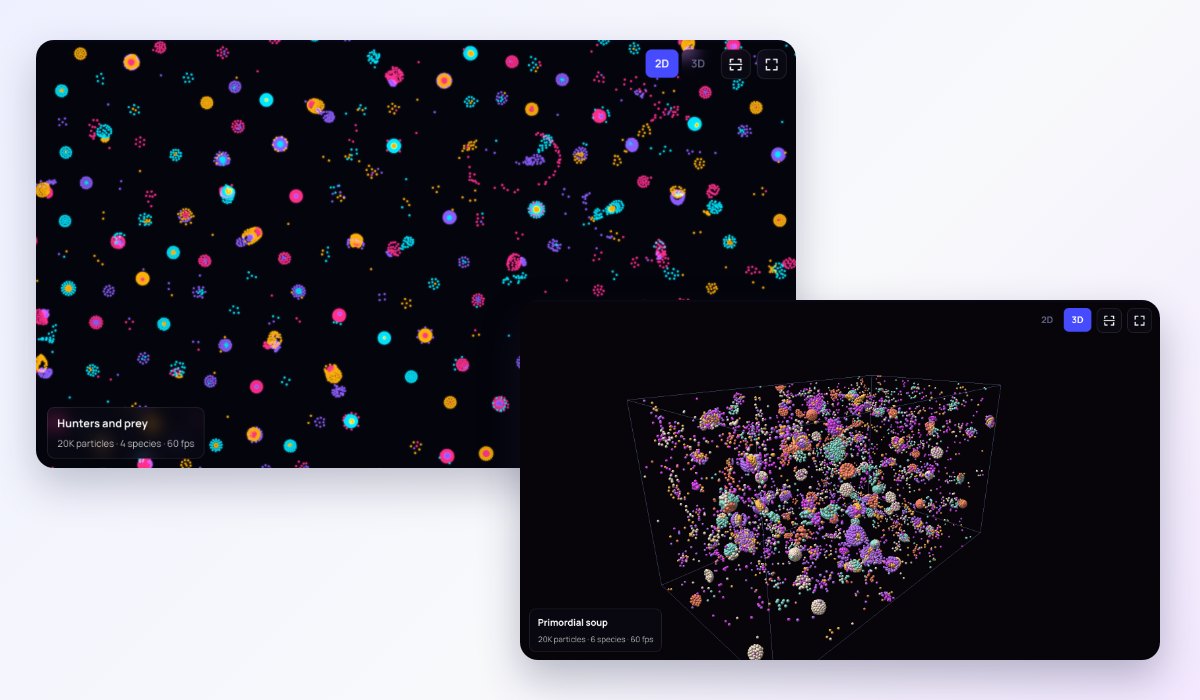
Colored particles that pull and push each other by simple rules, and out of them come cells, worms and hunters, in 2D and 3D.
What is Online Particle Life Simulator?
Particle Life Simulator is an artificial life simulation. There are a few species of particles, each a color, and one rule between every two of them: how strongly one is pulled towards, or pushed away from, the other. Nothing else is programmed in, yet out of those rules come cells with walls, worms that crawl, swarms that hunt and creatures that split, merge and chase each other.
It runs on your graphics card with WebGPU, so up to a quarter of a million particles move in real time, in a flat world or in a 3D box you can turn around. Choose a life form, roll a new one, change the rules while it runs, and record a video of it.
What You Can Do
- Life forms: start from primordial soup, living cells, hunters and prey, snakes, clans, a big bang, crystals or embers, or roll a new one.
- Rules: drag any square of the rules grid to change how one color feels another, and watch the creatures change at once.
- Evolve and mutate: nudge the rules a little, or let them drift by themselves.
- Play with it: pull particles together or push them apart with the mouse, and zoom in on a single cell.
- 2D and 3D: watch the same rules in a flat world or in a box you can turn.
- Make it yours: colors, glow, trails, sizes and music, then save a picture, record a video or share a link to your world.
How to use Online Particle Life Simulator?
- Pick a life form, or press the dice for a new one. It starts as a cloud of particles; give it a few seconds to organise.
- Change the rules in the grid, or press Mutate, and see what happens.
- Use Pull and Push to stir the particles, and scroll to zoom in on a creature.
- Switch to 3D, turn on trails or glow, then record a video or copy a link to share it.
Frequently asked questions
What is Particle Life?
Particle Life is a simple model of artificial life, made popular by Jeffrey Ventrella’s Clusters and Tom Mohr’s videos. Every particle feels the particles of every species near it: too close and they push apart, a little further and they pull or push by their rule. Because a rule does not have to be the same both ways, one species can chase another that runs away, and that is what makes the creatures move and hunt.
Why do the particles form cells?
A species that pulls on itself clumps together; another that is pulled towards it but pushed away from its own kind settles in a layer around it, like a cell wall. When the pulls are lopsided, the clump is pushed from one side and starts to swim. Nobody designs the cells: they are what the rules make stable.
Does it need a powerful computer?
It uses WebGPU, which current Chrome, Edge and Safari have, so most computers and phones run tens of thousands of particles smoothly. If yours slows down, choose fewer particles in World and Physics. Browsers without WebGPU run a lighter 2D version on the processor, with a few thousand particles.
Can I share what I made?
Yes. Copy the link: it holds the rules, the physics and the colors, so whoever opens it watches the same life form come to life. You can also save a picture or record a video, with music. For another world of simple rules, try the Game of Life Simulator or the Falling Sand Simulator.