Text Tools
 Image Tools
 PDF Tools
 Social Media Tools
 Security Tools
 Coding Tools
 CSS Tools
 Color Tools
 Miscellaneous Tools
 Add to Chrome
 Add to Firefox

Fire a cannon at any speed and angle, with or without air, on Earth or other worlds, and read the range, height and time.
What is Projectile Motion Simulator?
Projectile Motion Simulator fires a cannon in your browser: choose the launch speed, the angle and the height, pick a cannonball, a baseball, a golf ball or a feather, and watch it fly. It shows the range, the highest point, the time of flight and the speed it lands with, works them out with the textbook formulas beside the simulation, and lets you turn on air resistance to see how far the real path falls short of the perfect parabola. Fire the same shot on the Moon, Mars, Venus, Jupiter or Titan, hit a target, or sweep the angle in the Lab to find the one that goes furthest.
What it can do
- Launch with sliders or exact numbers, or drag from the cannon to aim and let go to fire, from the ground or from a tower of any height.
- Results: range, highest point, time of flight, landing speed and angle, the launch speed split into its parts, and the angle that goes furthest.
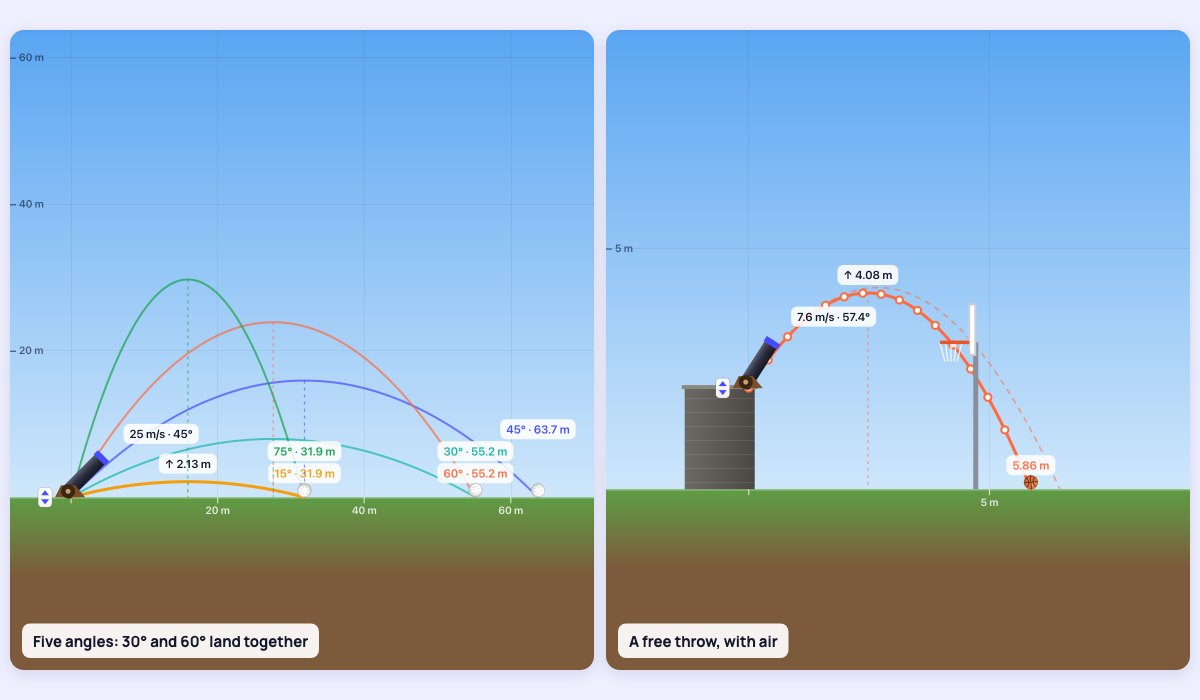
- Air resistance and wind for 14 objects, from a ping-pong ball to a piano, or your own mass, size and shape, with the path it would take without air dashed beside it.
- Other worlds: the Moon, Mars, Venus, Jupiter, Titan, Mercury, Pluto or any gravity and air you like, one at a time or side by side.
- See the motion: dots at even times, velocity arrows split into horizontal and vertical parts, the forces, and the numbers at any point under the pointer.
- Graphs and formulas: height, distance, both speeds and energy against time, and each formula worked through with your numbers.
- Targets: place one and let Aim for me find the two angles that hit it, or take on a challenge in as few shots as you can.
- A Lab that sweeps the angle, speed, height, mass or gravity and charts the range, height or time, with and without air, saved as CSV.
- 18 variations, from why 45° goes furthest to the monkey and the hunter, the hammer and the feather on the Moon, and golf on the Moon.
How to use it
- Set the speed, the angle and the height, with the sliders or by typing, or drag from the cannon and let go.
- Press Fire, or Space. Each shot keeps its colour and stays on the field, so you can compare them; Clear starts again.
- Choose an object and turn on air resistance to see the difference air makes, with the airless path dashed.
- Pick another world, or tick Compare worlds to fire the same shot on several at once.
- Open Graphs and formulas, Target, Shots and Lab below the field to go further.
The physics of a projectile
Once it leaves the cannon, a projectile without air feels only gravity, pulling straight down. So its motion splits into two that do not affect each other: across, it keeps the same speed, v₀·cos θ, for the whole flight; up and down, it starts at v₀·sin θ and loses g of it every second, as if thrown straight up. Together they make a parabola. That is why a ball dropped and a ball thrown sideways from the same height land at the same moment.
From level ground, the time of flight is t = 2·v₀·sin θ / g, the highest point H = v₀²·sin²θ / 2g and the range R = v₀²·sin 2θ / g. As sin 2θ is largest at 90°, the range is largest at 45°, and angles that add up to 90°, such as 30° and 60°, land in the same place. From a height h, the time is t = (v₀·sin θ + √(v₀²·sin²θ + 2gh)) / g, and the best angle is a little lower than 45°.
Air changes everything. It pushes back with a force of ½·ρ·C·A·v², which grows with the square of the speed, so a fast ball loses much of its speed early on, falls more steeply than it rose, and lands well short of the parabola. The best angle drops below 45°, and heavy, small things such as a shot put suffer least while light, large ones such as a ping-pong ball suffer most. There is no formula for this path, so the simulator works it out in thousands of tiny steps with the Runge–Kutta method.
Ideas to try
- Find the best angle: run the Lab on the angle from 0° to 90°, without air and then with it, and compare the peaks.
- Two angles, one landing: fire at 20° and 70°, then at 35° and 55°.
- Double the speed and watch the range grow four times, not two.
- Same throw, six worlds: on the Moon it flies six times as far as on Earth.
- Mass does not matter without air: try a feather and a bowling ball, then turn the air on.
- Score a free throw, then change the speed and let Aim for me find the new angles.
Frequently asked questions
Is this projectile motion simulator free?
Yes. There is nothing to sign up for or install, and it runs entirely in your browser, on a phone as well as a computer. A link carries your launch inside it, so a teacher can share a setup with a class.
Why does 45° go furthest?
The range is the speed across times the time in the air. A higher angle gives more time in the air but less speed across, and a lower angle the other way round. The product, v₀²·sin 2θ / g, is largest when 2θ is 90°, so θ is 45°. That holds only from level ground and without air: launched from a height, or through air, the best angle is lower.
How accurate is the air resistance?
It uses the standard drag law with typical drag coefficients for each object, at sea-level air on Earth and the surface air of the other worlds, which is a good model for balls and shells. It leaves out spin, which makes a golf ball rise and a curveball curve, and the change of drag with speed near the speed of sound.
Does the mass of the projectile matter?
Not without air: gravity pulls a heavier object harder, but it is harder to move by just as much, so everything falls alike, as the hammer and the feather did on the Moon. With air it does, because the same push of the air slows a light object more. For more physics, try the Gravity Simulator and the Solar System Simulator.