Text Tools
 Image Tools
 PDF Tools
 Social Media Tools
 Security Tools
 Coding Tools
 CSS Tools
 Color Tools
 Miscellaneous Tools
 Add to Chrome
 Add to Firefox


Follow box breathing, 4-7-8 and other exercises with an animation, tones and a voice, and keep a streak.
Box breathing · 4 · 4 · 4 · 4 · 3.8 breaths a minute
Four equal sides: breathe in, hold, breathe out and hold again, four seconds each. Also called square breathing or four-square breathing, it is taught to soldiers, athletes and nurses to steady the mind in stressful moments.
12 rounds of 0:16, 3:12 in all: a session always ends with a whole breath out.
Sessions of a minute or more are kept here, in this browser only: nothing is sent anywhere.
What is Breathing Timer?
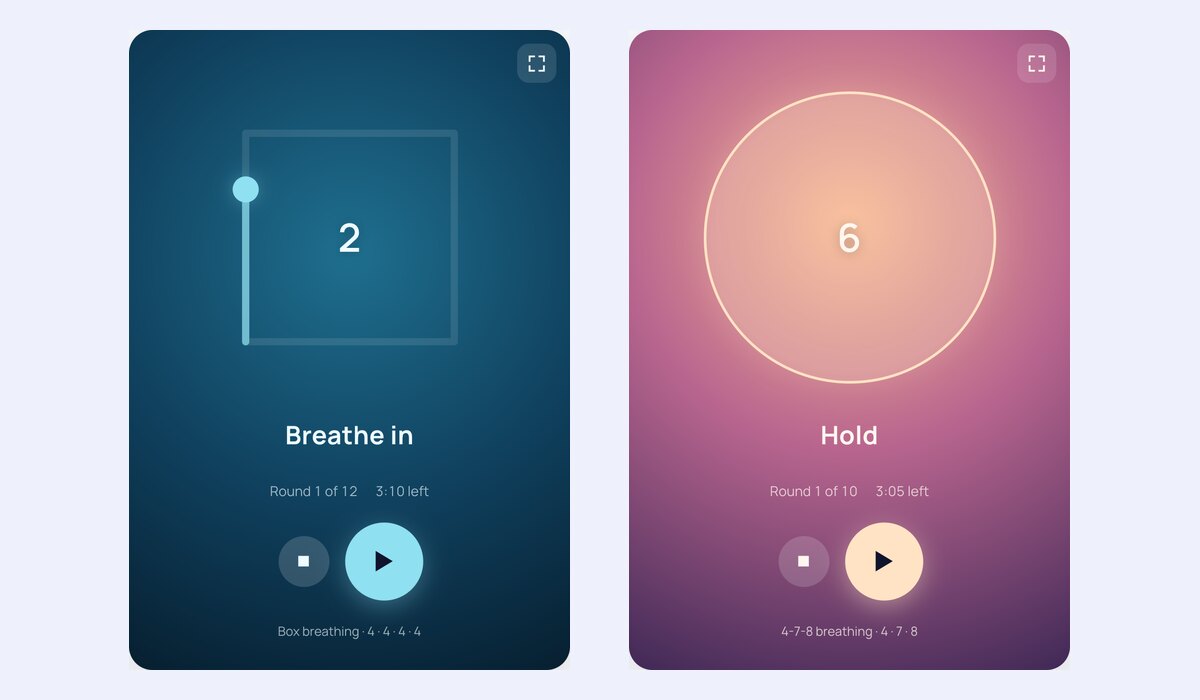
Breathing Timer guides you through breathing exercises one breath at a time. A circle grows as you breathe in and shrinks as you breathe out, or a dot travels around a box, while a soft tone rises and falls with the breath, so you can follow with your eyes closed. Choose box breathing, 4-7-8, resonant breathing, the physiological sigh or your own rhythm, and the length of the session.
What it does
- Eight patterns: box breathing (4-4-4-4), 4-7-8, resonant or coherent breathing (5.5-5.5), the physiological sigh, a calming 4-6 breath, triangle and equal breathing, and your own pattern in half seconds.
- Two guides: a circle that fills and empties with the lungs, or a dot around a box or triangle, with the phase and the seconds left in the middle.
- Follow with your eyes closed: a tone that rises as you breathe in and falls as you breathe out, or a soft chime at each phase, and spoken guidance if you like.
- Vibration at each phase on Android phones, for breathing in a quiet room or in the dark.
- Calming sounds under the breath: rain, ocean waves, a stream, wind or noise, made in your browser.
- Whole rounds: a session always ends after a complete breath out, with a bowl to finish.
- Your streak: every session counts towards the same practice log as the Meditation Timer, kept in your browser only.
- Full screen with the screen kept on, in five calm colours.
How to do box breathing
- Sit up comfortably and breathe out fully.
- Breathe in slowly through the nose for four seconds, as the dot goes up the side of the box.
- Hold the breath for four seconds along the top.
- Breathe out through the mouth for four seconds down the other side.
- Hold with empty lungs for four seconds along the bottom, and begin again. A few minutes is enough.
Which breathing exercise should I choose?
For stress in the moment, before a talk or an exam, box breathing or a few physiological sighs are quick and discreet. To fall asleep, the 4-7-8 breath and the calming 4-6 breath lengthen the breath out, which slows the body down. For a daily practice of ten to twenty minutes, resonant breathing at about five and a half breaths a minute is a good choice. If holding the breath is uncomfortable, choose triangle, equal or calming breathing, which have short or no holds.
Frequently asked questions
What is 4-7-8 breathing?
A breathing exercise popularised by Dr. Andrew Weil: breathe in through the nose for 4 seconds, hold for 7, and breathe out through the mouth for 8. It is usually done for four breaths at a time, often in bed to wind down. The timer counts every phase for you and stops after a whole breath out.
How long should a breathing session be?
One to three minutes is enough to feel calmer. Five to ten minutes makes a good daily habit, and resonant breathing is often practised for ten to twenty minutes. Start short, and stop whenever you like.
Can I breathe with my eyes closed?
Yes. With rising and falling tones the pitch goes up while you breathe in, falls while you breathe out and is silent while you hold, so you can follow the rhythm without looking. Add spoken guidance or vibration if you prefer.
Is it safe?
Gentle breathing exercises are safe for most people, but they are not medical treatment. Breathe comfortably and never strain; if you feel dizzy, light-headed or short of breath, stop and breathe normally. If you are pregnant or have a heart or lung condition, ask your doctor before trying long breath holds.
Does it work offline or on my phone?
It works on any phone, tablet or computer in the browser, with nothing to install. All sounds are made on your device, and your practice log never leaves it. On phones the screen is kept on during a session.