Text Tools
 Image Tools
 PDF Tools
 Social Media Tools
 Security Tools
 Coding Tools
 CSS Tools
 Color Tools
 Miscellaneous Tools
 Add to Chrome
 Add to Firefox


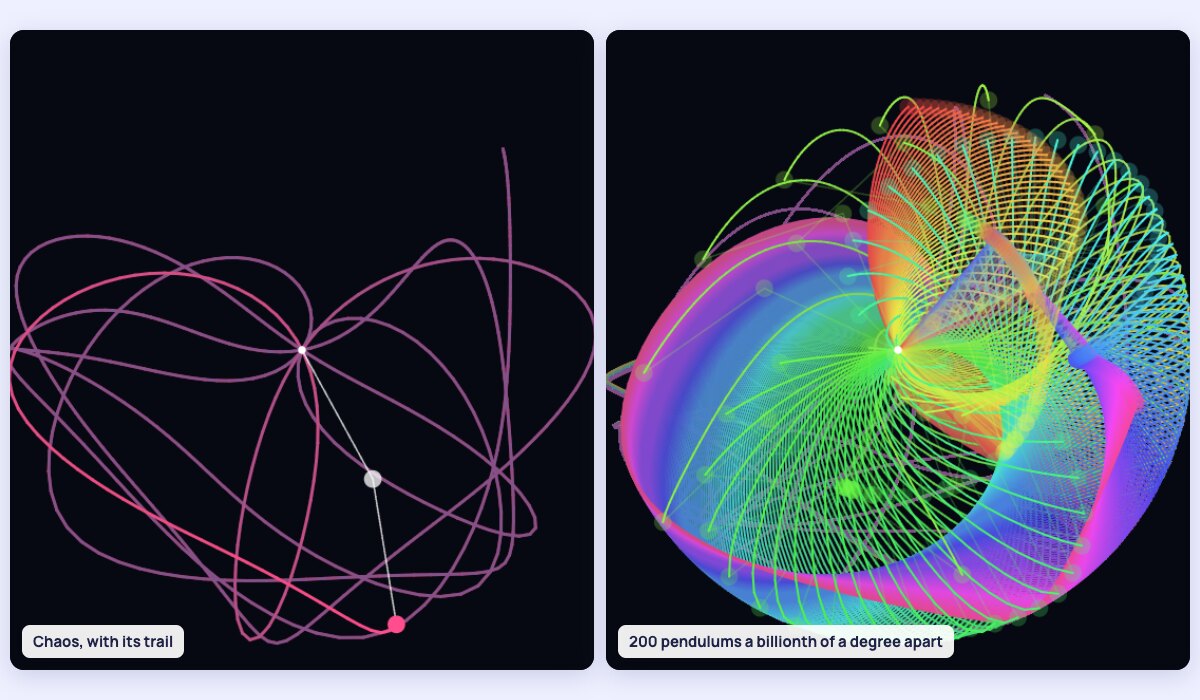
Swing a double pendulum, or hundreds a billionth of a degree apart, and watch chaos draw its path in real time.
Pick a start, or drag the bobs on the picture. Every start is exact, so the same start always swings the same way.
What is Double Pendulum Simulator?
A double pendulum is a pendulum with a second pendulum hanging from its end. With small swings it moves calmly, but raise the arms high and it becomes one of the simplest examples of chaos: its motion never repeats, and the smallest change to where it starts leads, within seconds, to a completely different swing.
Double Pendulum Simulator solves the pendulum's equations of motion a thousand times a second with the fourth-order Runge–Kutta method, so what you see is real physics: the energy stays the same to a tiny fraction of a percent, and the same start always gives the same swing.
Features
- Drag the bobs to set the starting angles, then let go.
- Butterfly effect: run up to 500 pendulums whose angles differ by a billionth of a degree, and watch them stay together, then burst apart.
- Trails that fade, or stay forever to draw a picture, in a dark or light theme.
- Physics: both masses and lengths, gravity on Earth, the Moon, Mars or Jupiter, and friction.
- Starting points: chaos, gentle swings, the two normal modes, a pendulum balanced upside down, and flips.
- Graph and energy: both angles over the last 20 seconds, and the total energy.
- Save a picture or record a video.
How to use Double Pendulum Simulator?
- Press Play, or pick a starting point such as Chaos or Butterfly effect.
- Drag the upper or lower bob to a new angle; it swings from there when you let go.
- Change the masses, lengths and gravity under Physics.
- Set the trail to Forever and hide the arms to let the pendulum draw, then save the picture.
Frequently asked questions
Why is the double pendulum chaotic?
The two arms keep pushing and pulling each other, and how hard depends on both angles and both speeds at once. That feedback makes tiny differences grow exponentially. The motion follows exact laws, yet it cannot be predicted far ahead unless the start is known perfectly, which is what chaos means.
What is the butterfly effect?
It is the name for this sensitivity to the start: a butterfly's wing beat could, in principle, change the weather weeks later. Choose the Butterfly effect start to see it: 200 pendulums only a billionth of a degree apart swing as one for a while, then fan out into a rainbow.
Is a double pendulum always chaotic?
No. With small angles it is nearly regular, and with the two normal modes (both arms in step, or in opposite directions, with the lower angle √2 times the upper) it swings in a steady rhythm. Chaos appears once the arms swing high, especially when the lower one goes over the top.
What equations does it use?
The standard equations for two point masses on light, rigid rods, derived with Lagrangian mechanics, plus optional friction proportional to speed. They are integrated in steps of one millisecond with the Runge–Kutta method. For other simulations, try the Mandelbrot Zoom and the Galton Board Simulator.