 Text Tools
 Image Tools
 PDF Tools
 Social Media Tools
 Security Tools
 Coding Tools
 CSS Tools
 Color Tools
 Miscellaneous Tools
 Add to Chrome
 Add to Firefox
Structurally valid IBANs with a correct mod-97 check digit, from 15 characters in Norway to 31 in Malta.

What is Online Fake IBAN Generator?
Fake IBAN Generator is a free online tool that creates random fake IBAN numbers you can use for testing. You pick a country, choose how many you need, and it spits them out. The IBANs follow the real format for each country — correct length, right country code, valid check digits — but they are completely made up and not connected to any real bank account.
If you have ever worked on a fintech project or any app that handles payments, you know you can't just throw real bank details into your test environment. That's where this comes in handy. You get properly formatted IBANs without touching anything real.
What is an IBAN anyway?
IBAN stands for International Bank Account Number. It's basically a standardized way to identify bank accounts across different countries so that international transfers actually work without getting lost somewhere in the system. An IBAN can be up to 34 characters long and it's made up of a few parts:
- Country code — 2 letters at the beginning (like DE for Germany, GB for UK)
- Check digits — 2 numbers right after the country code, used for validation
- The rest is called BBAN (Basic Bank Account Number) which includes bank code, branch code, and account number
Every country has a different IBAN length. Germany uses 22 characters, France uses 27, Norway uses 15. There is no single universal length which is part of what makes IBAN validation annoying to implement in code. The check digits at position 3-4 are calculated using a specific algorithm (MOD 97) which is how systems verify if an IBAN is structurally valid. This tool generates IBANs that pass that check too.
Why would you need fake IBANs?
Mostly for development and testing. Here are the common cases where people use this tool:
- Testing payment forms and checkout flows — you need IBANs that pass frontend validation but aren't real
- Building banking or fintech apps and you need seed data for your database
- Creating design mockups for financial products and you want realistic-looking data in the screenshots
- Writing documentation or tutorials that show IBAN examples without using anyone's actual account
- Running automated tests where you need hundreds of valid-format IBANs
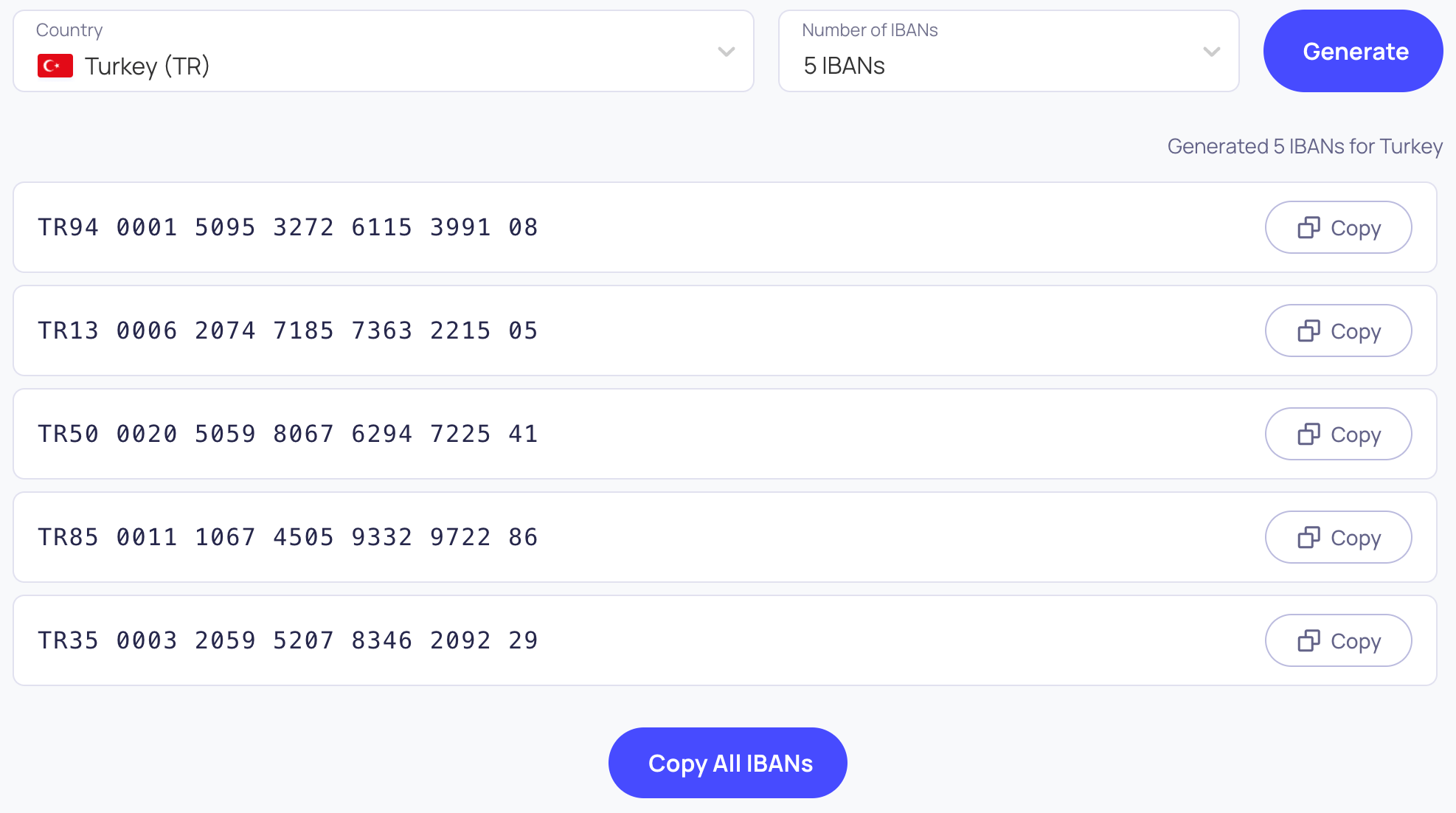
The tool supports over 35 countries right now — everything from Germany, France, UK, and Spain to Turkey, Saudi Arabia, UAE, and Egypt. Pretty much all the SEPA countries are covered plus a bunch of others that use the IBAN system.
One thing to be clear about: these IBANs are fake. Don't try to use them for actual bank transfers or any real financial transaction. They exist purely for testing and development. They might pass format validation but they won't pass a real bank's verification system.
How to use Online Fake IBAN Generator?
Pretty straightforward.
- Pick a country from the dropdown. Each country has its own IBAN format so this matters.
- Select how many IBANs you want — you can generate 1, 5, 10, 25, 50, or up to 100 at once.
- Hit Generate.
- Copy the ones you need individually, or grab all of them at once with the copy all button.
Everything runs in your browser, nothing gets sent to a server. So if you are generating test data for a client project, nobody else is seeing it.
Frequently asked questions
Are these real bank accounts?
No. They follow each country's IBAN structure and carry a correct check digit, so validation passes — but they are not issued by any bank and no account exists behind them.
What are they for?
Testing. Filling a form, seeding a database, checking that your validation accepts the right shapes and rejects the wrong ones, and taking screenshots without exposing anyone's real details.
Why does IBAN length vary by country?
Because each country kept its own account and branch numbering when IBAN was standardised. The format defines the country code and check digits; the rest is whatever that country already used, so Norway needs 15 characters and Malta needs 31.
How does the check digit work?
A mod-97 calculation over the rearranged number. It catches typos and transposed digits, which is the whole point — it tells you a number is malformed, not that it belongs to anyone.
Can I use one for a real transaction?
No. There is no account on the other end, so a payment would simply fail. Anything else you might be considering would be fraud.
What other test data is there?
The List Randomizer and the Lorem Ipsum Generator cover random selections and placeholder text.