Text Tools
 Image Tools
 PDF Tools
 Social Media Tools
 Security Tools
 Coding Tools
 CSS Tools
 Color Tools
 Miscellaneous Tools
 Add to Chrome
 Add to Firefox


Measure your PD for glasses with your camera and a card: single, dual and near PD, all on your device.
Runs in your browser. Camera frames and photos never leave this device; only the numbers are kept here.
Any card the size of a bank card works (85.60 × 53.98 mm): a loyalty, library or gift card is fine. Hold it flat and level, long side across, numbers facing away.
- Sit an arm’s length from the camera, face evenly lit, glasses off.
- Hold the card where the dashed outline shows until it turns green.
- Keep your head straight and look at the lens while 30 good frames are collected.
- Check the frozen picture, fine-tune the handles if needed, and download your PD card.
On-screen PD ruler
Hold any bank or ID card against the screen and move the slider until the outline is exactly as wide as the card. Saved in this browser for next time.
Stand about 20 cm from a mirror and hold the screen just under your eyes, facing the mirror. Close your right eye and line the 0 up with your left pupil, then close your left eye: the right pupil should sit on the blue mark. Turn on mirrored numbers to read them in the mirror.
Numbers are centimetres; each small tick is 1 mm.
What is pupillary distance?
Pupillary distance (PD) is the distance between the centres of your two pupils, in millimetres. Every pair of prescription glasses needs it: the optical centre of each lens has to sit right in front of the pupil it serves, otherwise the lens bends light sideways and you look through it at a slight prism. That is why the PD is often missing from a prescription and why online shops ask for it before you can order frames.
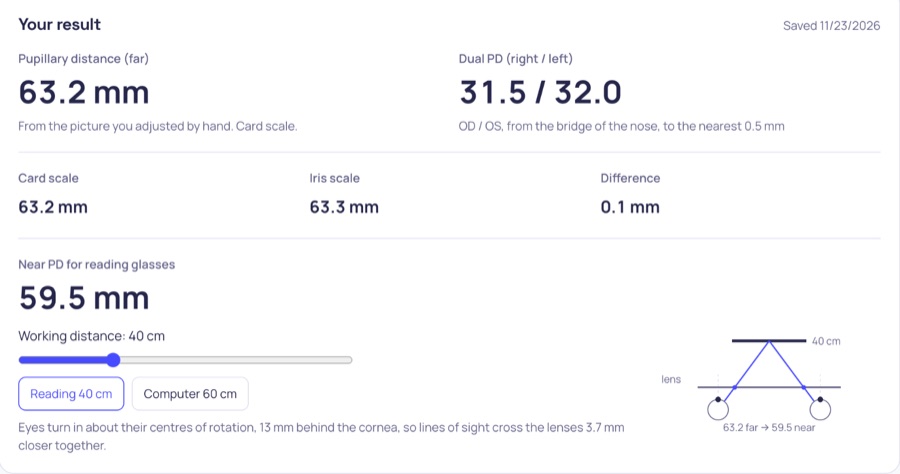
This PD meter lets you measure PD online with the camera you already have and a plastic card from your wallet. It finds your irises with a face model that runs in the browser, scales the picture with the card, collects thirty steady frames and gives you the median with its spread, your dual PD for each eye, and your near PD for reading glasses. Nothing is uploaded: the camera picture is analysed on your own device and only the numbers are kept, in this browser.
How to measure pupillary distance at home
- Take off your glasses, sit facing a window or a lamp so your face is evenly lit, and place the screen about an arm's length away.
- Pick up any card the size of a bank card: a loyalty, library, gym or gift card works just as well, numbers facing away. Every one of them is made to the same ISO size, 85.60 × 53.98 mm.
- Press Start camera. Hold the card flat against your forehead, long side across, inside the dashed outline (or choose Under the nose if your fringe gets in the way). When the tool locks on to both short edges, the outline turns green.
- Keep your head straight. Three small gauges show turn, tilt and roll; frames only count while every dot is in the green zone, within about 4 degrees.
- Look at the camera lens, not at the screen, while the ring fills with 30 good frames.
- Check the frozen picture. If a crosshair is not quite on a pupil or a green line is off the card's edge, drag it; a loupe magnifies the spot. Then download your PD card, a picture with your values and the date to keep or send to the optician.
No webcam? Choose Upload a photo and use a picture taken straight on with the card in the same place. A phone's rear camera held at arm's length by someone else gives a very clean picture. Without a card at all, the No card (quick) mode uses the size of your iris as the ruler; it is handy for a rough figure but less accurate, because irises differ from person to person.
Why a card, and what the tool corrects for
A camera sees in pixels. To turn pixels into millimetres you need something of known size at the same distance as your eyes, and a standard card is the most precise ruler most people own. Each picture is measured twice, with two independent scales: once with the card and once with your iris, whose visible diameter is about 11.7 mm in adults. Both are shown side by side; if they disagree by more than 2 mm, the tool tells you, which usually means the card was tilted or one of its edges was misread.
There is one subtle error most online PD tools ignore. A card resting on your forehead or under your nose is roughly 12 mm closer to the camera than your pupils, so it looks slightly bigger than it would at the depth of your eyes, and a naive measurement comes out too small, often by a millimetre or more. This tool estimates how far you are from the camera (from the card, your iris and the width of your face) and scales the result by (D + 12) / D to put the card back in the plane of your pupils.
It also measures from the centre of each iris as the face model finds it, rather than from a single click, and takes the median of thirty frames, so one blink or a bad frame does not move the result. The ± figure is the spread of those frames: with a steady head and a well-placed card it is usually under 1 mm.
Single PD and dual PD
A single PD is one number, for example 63 mm. A dual PD, also called monocular PD, splits it into two: the distance from the bridge of your nose to each pupil, written as right / left, for example 32 / 31.5. Faces are rarely perfectly symmetrical, and a difference of half a millimetre to a millimetre between the two sides is normal. Progressive and high-power lenses should always be made with a dual PD; for simple single-vision glasses most shops accept either.
Opticians write the right eye first and call it OD (oculus dexter); the left is OS (oculus sinister). The picture here is shown as someone facing you would see it, so your right eye, OD, appears on the left. Switch on Mirror view if you find it easier to line up the card in a selfie view; the labels follow your eyes either way.
Near PD for reading and computer glasses
When you look at something close, both eyes turn inwards. They rotate about a point about 13 mm behind the front of the eye, so the lines of sight cross the lenses of your glasses closer together than when you look into the distance. Reading glasses therefore need a near PD, usually about 3 to 4 mm less than the distance PD. Set your working distance with the slider, or choose Reading 40 cm or Computer 60 cm, and the diagram shows the converging lines of sight with the result. Glasses for the computer only sit between the two, which is why office lenses are often ordered with a PD 1 to 2 mm below the distance value.
Average PD: what is normal?
The average PD for adults is about 63 mm: roughly 64 mm for men and 62 mm for women, with most adults between 54 and 74 mm. Children's PD is smaller and grows with them, typically 43 to 58 mm. If your result falls outside the adult range the tool warns you; it may simply be correct, but it is worth checking the handles and measuring again. Do not order glasses with an average value when you can measure your own: a few millimetres off is enough to cause eye strain with strong lenses.
Using the on-screen PD ruler
Screens have different pixel sizes, so a ruler on a screen is only true once it is calibrated. Hold your card against the display and move the slider until the outline is exactly as wide as the card; the PD ruler below is then drawn at real size and remembers the setting. Use it for the classic mirror check: stand about 20 cm from a mirror, hold the screen under your eyes facing the mirror, close your right eye and line the zero up with your left pupil, then close the left eye and see where the right pupil lands. It should fall on the blue mark that shows your measured PD. Turn on mirrored numbers to read them in the reflection.
Tips for an accurate PD measurement
- Glasses off. Lenses magnify or shrink your eyes and their frames hide the iris edges.
- Look at the lens of the camera, not at your face on the screen; looking slightly down makes the eyes converge a little.
- Hold the card flat against the skin and level. A card tilted forwards looks narrower and makes the PD read high.
- Light from the front. Strong side light leaves one iris in shadow and moves its centre.
- Measure twice. Two results within 1 mm of each other are as good as an optician's ruler; many opticians accept a PD within ±1 mm.
Privacy
The face model is downloaded once from a public CDN and then runs inside your browser. Camera frames and photos stay on your device: they are never uploaded, stored or shared. Only your numbers and settings are kept in this browser's local storage so they are there next time; the PD card image is drawn locally and saved straight to your device.
Disclaimer
This tool gives a measurement for ordering glasses and is not a medical device or an eye examination. It does not check your vision or your prescription. For complex lenses, high prescriptions, children or any doubt, have your PD measured by an optician, and see an eye care professional for regular eye tests.
Frequently asked questions
How accurate is measuring PD online?
With a card, a steady head and a picture checked by hand, results are typically within about 1 mm of an optician's pupillometer. Quick mode without a card is less accurate, around ±2 mm, because it relies on an average iris size.
Can I measure my PD without a card?
Yes, with the No card (quick) mode, which scales the picture by your iris. Use it for a quick check; for ordering glasses, any card the size of a bank card gives a better result.
Which card can I use?
Any card in the standard ID-1 size, 85.60 by 53.98 mm: bank and credit cards, loyalty and library cards, gift cards, many ID cards and driving licences. Keep the number side facing away from the camera.
Is PD on my prescription?
Often not. Many opticians measure it while fitting your frames and do not write it on the prescription. If it is there, it may appear as PD, P.D. or IPD, sometimes as two numbers for the right and left eye.
Does my PD change over time?
It grows through childhood and the teenage years and is stable in adults. It is worth measuring children again whenever they get new glasses.
Should I give the shop my single PD or dual PD?
Give the dual PD if the order form has two boxes, especially for progressive or varifocal lenses. Otherwise enter the single PD, which is the sum of the two.
Does it work on a phone?
Yes. It uses the front camera in the browser on iPhone and Android, with no app. Prop the phone up at eye level about an arm's length away, or upload a photo taken with the rear camera.