Text Tools
 Image Tools
 PDF Tools
 Social Media Tools
 Security Tools
 Coding Tools
 CSS Tools
 Color Tools
 Miscellaneous Tools
 Add to Chrome
 Add to Firefox

Scan your Rubik's cube with the camera or enter its colours, and solve it step by step on a 3D cube in about 20 moves.
Hold the cube with white on top and green facing you. Pick a colour, then tap or drag over the squares. The side faces are as you see them when you turn the cube left; the white top with green at the bottom, the yellow bottom with green at the top.
48 squares have no colour yet.
What is Rubik's Cube Solver?
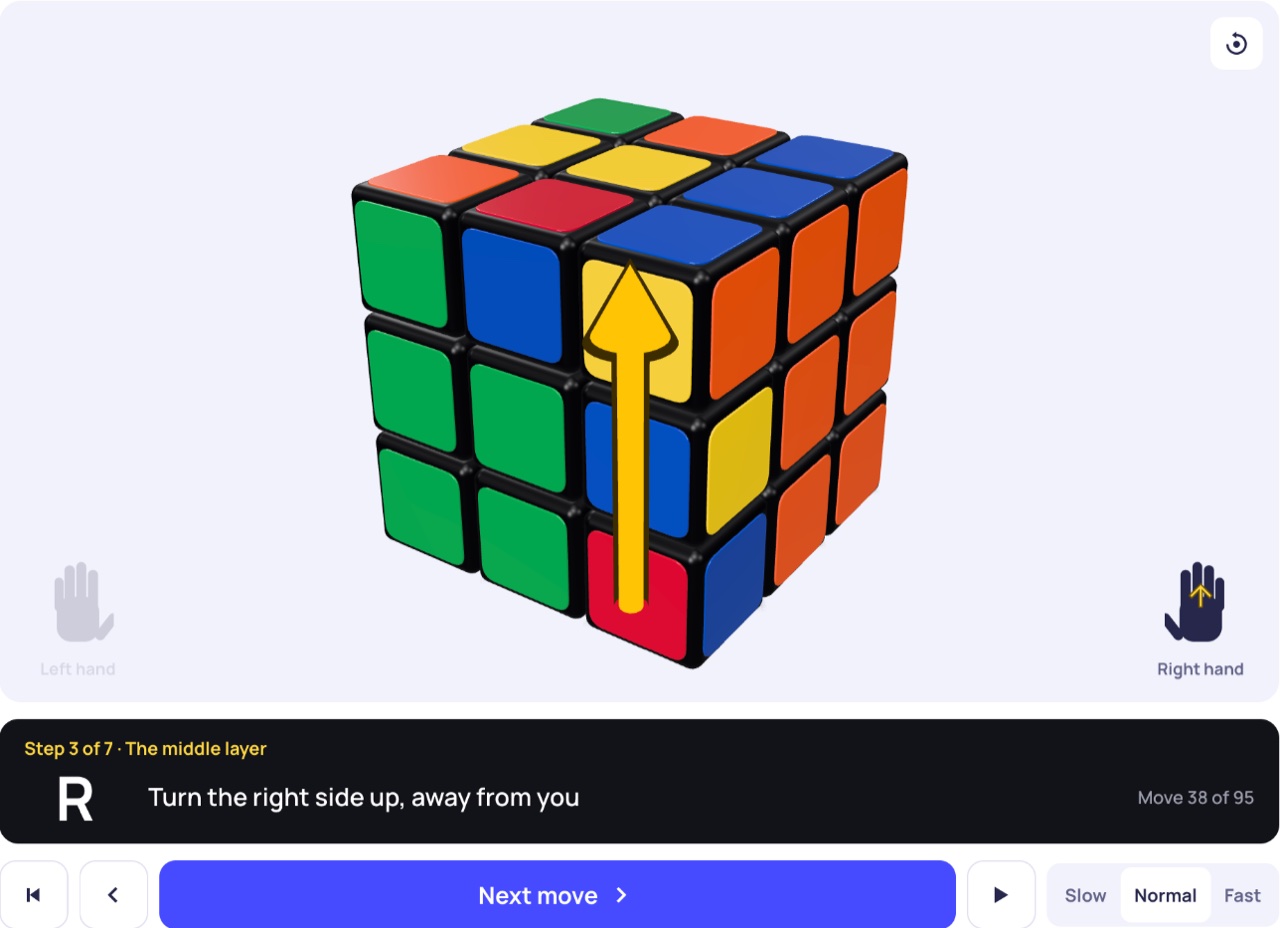
Rubik's Cube Solver works out the solution to your 3×3 Rubik's cube from its colours and walks you through it. Show each side to the camera, or tap the colours into a flat map of the cube, and the solution plays on a 3D cube that turns exactly as yours will: the layer to turn lights up, a yellow arrow shows which way, and the move is written in plain words, such as "Turn the right side up, away from you", with a picture of the hand that does it. Go forward one move at a time, step back, or let it play at slow, normal or fast speed.
Choose Fewest moves to solve the cube now in about 20 moves, using Herbert Kociemba's two-phase algorithm, the method behind most computer cube solvers. Or choose Layer by layer to be taken through the beginner method in seven stages, each explained, so you can learn to solve a Rubik's cube without help. It all runs in your browser: nothing is uploaded, not even the camera picture.
How to solve a Rubik's cube with the solver
- Hold the cube with the white centre on top and the green centre facing you. The centre pieces never move relative to each other, so they tell you which side is which.
- Read the colours. With Camera, show the six sides one after another as the page asks: green first, then round the sides, then white and yellow. Each side is captured by itself as soon as the picture is steady. With Enter colours, pick a colour and tap or drag over the squares of the flat cube. With Scramble, type the moves that mixed it up, e.g. R U2 F' L D2.
- Check the colours. The 3D cube next to the map shows what you entered. Any mistake is marked in red and explained, and the Solve button waits until the colours make a real cube.
- Choose the solution: fewest moves, or layer by layer.
- Follow the moves. Hold your cube as shown at the top, look at the lit layer and the arrow, turn your cube the same way, then press Next move. On a keyboard the arrow keys go forward and back and Space plays.
Rubik's cube solver with camera: tips for a clean scan
- Scan in daylight or under a white lamp. Yellow light from a warm bulb makes white look yellow and orange look red.
- Tilt the cube slightly so no sticker reflects the light; a glare spot reads as white.
- Fill the frame with the face and keep the cube still for a moment.
- At the end every square is compared with the six centres of your own cube, which fixes most red and orange mix-ups. Tap any square that is still wrong before solving.
How the colours are checked
One wrong colour makes a cube that cannot be solved, and most online solvers then just report an error. Here every mistake is found and explained in words, with the squares marked on the map and on the 3D cube:
- Counts: a cube has nine squares of each colour, e.g. "Red: 10 squares (1 too many)".
- Pieces that do not exist: a corner or edge with the same colour twice, with two opposite colours such as white and yellow, or a corner whose colours run the wrong way round.
- Pieces that appear twice, which means another one is missing.
- A twisted corner, a flipped edge or two swapped pieces: colours that are each possible but together could never come from turning. Usually one colour went on the wrong side; if the colours are right, the cube was taken apart or a corner was twisted, and the message says how to put it right.
How to solve a Rubik's cube: the beginner method
Layer by layer follows the method taught to most people who learn the cube. The cube is turned over so white is at the bottom and yellow on top, with green in front, and held that way to the end. Each stage is a few moves, and most of them are the same short sequences repeated, which is why it can be remembered.
1. The white cross
Put the four white edges around the white centre at the bottom, each with its other colour matching the centre beside it: the white-green edge under the green centre, the white-red under red, and so on. There is no formula for this stage; the solver finds a short way for each edge, and with practice you will see it yourself.
2. The white corners
Bring each white corner into the top layer above the place it belongs, between its two side colours, then drop it in with R U R′ or F′ U′ F, or repeat R U R′ U′ until it sits right. When all four are in, the whole bottom layer is solved.
3. The middle layer
Find an edge in the top layer with no yellow on it, turn the top until its front colour matches the centre below, then send it down to the right with U R U′ R′ U′ F′ U F or to the left with U′ L′ U L U F U′ F′. Four edges and two layers are done.
4. The yellow cross
Make a yellow cross on top with F R U R′ U′ F′, repeated from a dot, an L or a line. The sides of the cross do not need to match yet.
5. The yellow face
Turn the yellow corners so the whole top is yellow with R U R′ U R U2 R′, the algorithm cubers call the Sune.
6. The yellow corners
Move the corners into their places with R′ F R′ B2 R F′ R′ B2 R2, so each one matches the sides around it.
7. The yellow edges
Cycle the last three edges with R U′ R U R U R U′ R′ U′ R2 or its mirror R2 U R U R′ U′ R′ U′ R′ U R′. The cube is solved.
The beginner method takes more moves than the shortest solution, usually over a hundred, but after a few solves with the solver showing each stage you will be able to do it from memory. A first solve on your own often takes five minutes or more; with practice, under two.
Rubik's cube notation
- R, L, U, D, F, B turn the right, left, up (top), down (bottom), front and back faces a quarter turn clockwise, as seen looking straight at that face.
- R′ (R prime) turns it anticlockwise; R2 turns it twice, half a turn.
- The cube is never turned over during a solution: hold it the same way from the first move to the last.
- The plain words do the translating for you: R is "the right side up, away from you", U is "the top layer to the left", F is "the front face clockwise, like a steering wheel to the right".
Frequently asked questions
How many moves does it take to solve a Rubik's cube?
Any position can be solved in 20 moves or fewer, a number known as "God's number" and proved in 2010. The Fewest moves solution here usually takes 19 to 22 moves.
Can I solve a Rubik's cube by taking a photo?
Yes: the camera reads one face at a time, which is more reliable than a single photo because each face is seen straight on. The six faces take less than a minute.
The camera mixes up red and orange. What can I do?
Scan in daylight or under a white lamp, without glare on the stickers. The colours are matched to your own centres at the end, which fixes most mix-ups, and you can tap any square to correct it before solving.
Why does it say my cube cannot be solved?
Usually a colour was entered wrongly. Otherwise the cube was taken apart, or a corner twisted, and put back in a position no turning can undo. The message names the problem and marks the squares to check.
Does it work for 2×2 or 4×4 cubes?
Not yet: it solves the standard 3×3 cube, with any colour scheme as long as the centres are entered as they are on your cube.
Is it cheating to use a cube solver?
Not if you want to learn. Solving a scrambled cube with Layer by layer a few times is one of the quickest ways to understand the method, and Fewest moves is handy when a cube has been sitting mixed up in a drawer for years.
How do I get faster?
Time your solves with the Rubik's Cube Timer: competition-style scrambles, inspection and ao5 and ao12 averages. Once the beginner method is comfortable, most cubers move on to CFOP.