Text Tools
 Image Tools
 PDF Tools
 Social Media Tools
 Security Tools
 Coding Tools
 CSS Tools
 Color Tools
 Miscellaneous Tools
 Add to Chrome
 Add to Firefox

Swing a Newton's cradle in 2D or 3D, change its rules, or build your own with strings, rods, springs and walls.
Drag a ball to lift it, push it or throw it; it pushes the balls in its way. Drag the background to move the view, scroll or pinch to zoom.
Each one starts at once. Change anything after: the rules, the balls, or build on it with the tools above.
What is Newton's Cradle Simulator?
A Newton's cradle is a row of steel balls hanging side by side. Lift the first and let it go, and the last one flies out on the far side while the others hardly move. Newton's Cradle Simulator runs one in real time in your browser, in 2D or 3D, and lets you change everything about it: how many balls there are, what they are made of, the rules they follow, and even the cradle itself. Draw your own with balls, strings, rods, springs and walls, and watch it run.
What it can do
- Real physics: the balls press into each other for a moment and push back, by the law of two elastic spheres, so the hit travels along the row as it does through steel. Or choose instant hits, as in a physics book.
- Your rules: bounciness from perfectly elastic to not at all, gravity of the Earth, the Moon, Mars, Jupiter, none or your own, air resistance, a floor or none, and balls that keep to one line or swing any way.
- Build your own: hang pendulums that snap into a row, place free balls and throw them, tie strings, rods and springs between anything, draw walls and ramps, and change each ball’s size, material and colour.
- 19 variations: one, two or three balls, both sides at once, ten balls, gaps, a heavy or a light hitter, putty, big to small, a double-decker cradle, a wall, a ball stack drop, a ramp, springs, the Moon and a swing out of line.
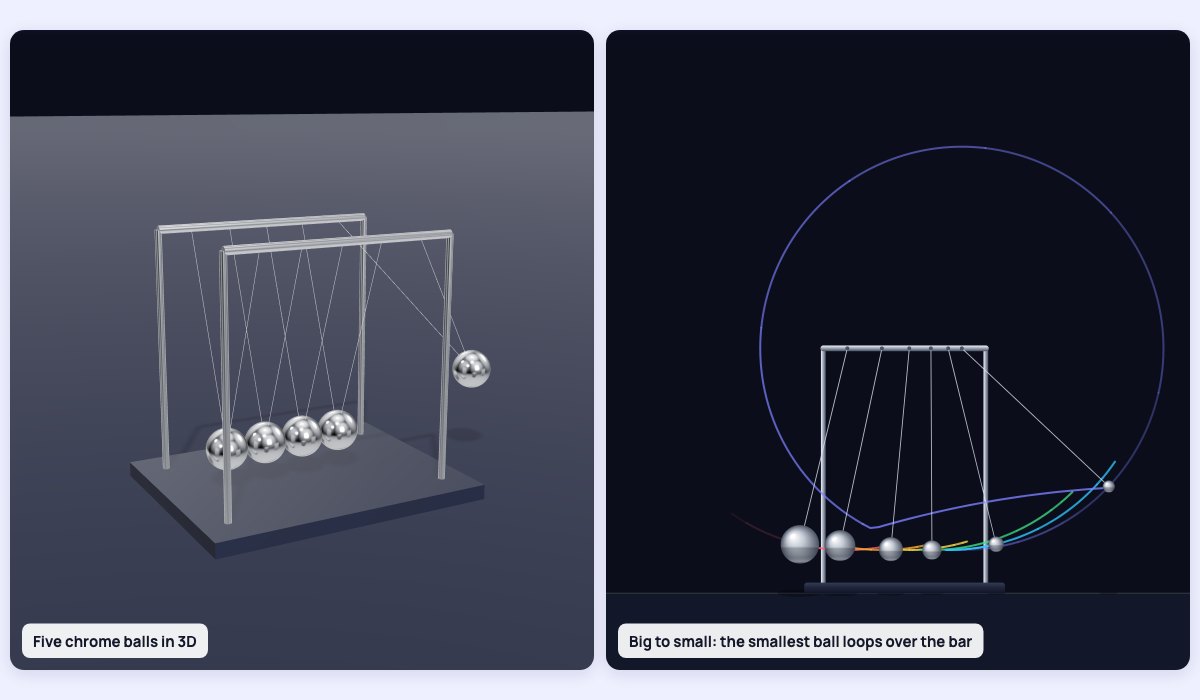
- 2D and 3D: a clean side view for building, and chrome balls in 3D with reflections and shadows that you can turn, zoom and pull in any direction.
- Measure it: kinetic, potential and total energy, momentum, the number of hits, and graphs of every ball’s position and speed.
- Watch closely: slow motion down to a tenth, slow motion at each hit, trails, speed arrows and the click of the balls.
- Share it: a link that opens your cradle as it is, a file to keep, a picture or a video.
How does a Newton's cradle work?
Two things are kept in every hit between hard steel balls: momentum (mass times speed) and, nearly all of it, kinetic energy. When one ball hits a row of balls of the same mass, the only way to keep both is for one ball to leave at the same speed. Two balls leaving at half the speed would carry the same momentum, but only half the energy; so one ball in sends one ball out, and two in send two out.
That is the textbook answer, and the Instant hits rule follows it exactly: each pair of balls swaps its motion in turn, from one end of the row to the other, and the cradle keeps going the same way for ever. A real cradle is subtler. The balls touch, so the hit is not a string of separate collisions but a pulse of squeezing that runs through the steel in a fraction of a millisecond. Because steel spheres stiffen as they are squeezed (the force grows as the squeeze to the power 3/2, found by Heinrich Hertz), the pulse stays short and passes almost all its energy to the last ball. Almost: a little is left behind in the others, which is why a real cradle slowly loses its neat rhythm and, after a while, all its balls swing together.
The Elastic contact rule simulates that squeeze, in steps of 50 microseconds, so you can see both: the classic one in, one out, and the slow mixing that follows. Lower the bounciness a little, choose the Slowly together variation, and the five balls end up swinging as one within half a minute.
How to use it
- It starts at once with one ball lifted. Press Pause or Space to stop it, and the arrow to go back to the start.
- Drag any ball with the Pull tool to lift it, and let go. A ball you pull pushes the others out of its way, so drag the second ball to lift two.
- Pick a variation, or set the number of balls, their size, material, the gap and how many are lifted under Cradle.
- Change the rules under Rules while it runs: bounciness, gravity, air resistance and how the balls hit.
- Build your own with the tools: Pendulum to hang balls in a row, Ball for free balls, Link for strings, rods and springs, Wall for walls and ramps, Select to change or move anything, Eraser to take it away.
- Switch to 3D to see it in chrome, turn it with a drag, and pull a ball off to the side when the balls may swing any way.
Ideas to try
- Lift two from the left and one from the right: which side wins, and why does it never change?
- Make the first ball tungsten: it is two and a half times as heavy, and the cradle cannot send out one ball any more.
- Grade the balls from big to small: the energy piles into the smallest, which shoots off far higher than the first was lifted.
- Turn gravity off and throw a free ball into the row: the hit still passes through, but nothing swings back.
- Hang the balls on springs, or a ball under each ball, and watch order turn into chaos.
- Drop a stack of balls on the floor: the top one bounces up much higher than it fell, the trick of a basketball with a tennis ball on top.
Frequently asked questions
Is this Newton's cradle simulator free?
Yes. There is nothing to sign up for or install, and it runs entirely in your browser, on a phone as well as a computer. Your cradles are not uploaded: a shared link carries the whole cradle inside it.
Why does lifting two balls send out exactly two?
Momentum and energy have to come out as they went in. Two balls arriving at a speed carry twice one ball’s momentum and twice its energy; the only way for balls of the same mass to leave with both is two balls at that same speed. One ball at twice the speed would carry the right momentum but twice the energy, which cannot come from nowhere.
Are the hits in a Newton's cradle elastic collisions?
Nearly. In an elastic collision both momentum and kinetic energy are kept, and hard steel balls come close, losing only a few percent of the energy in each hit. In an inelastic one, momentum is still kept but some energy turns into heat and sound; putty balls, as in the Putty variation, hardly bounce at all, so they share the hit and move off together. Lower the bounciness under Rules or choose a softer material, and the Measurements section shows the momentum staying the same while the energy drops, so the simulator also works as a collision simulator for one, two or many balls.
Why does a real cradle stop working after a while?
Each hit leaves a little motion in the middle balls, and each one loses a little energy as heat, sound and in the strings. The left-over motions add up until the balls are no longer still when the next ball arrives, and the hits blur into all the balls swinging together. The elastic contact rule shows the first part even with a bounciness of 1; a bounciness below 1 adds the second.
Does it keep energy exactly?
With rods or instant hits, a bounciness of 1 and no air, the total energy stays the same to a few thousandths of a percent, however long it runs: the motion is followed with velocity Verlet steps and the strings held at their length with SHAKE and RATTLE. Strings that go slack for a moment and snap taut again lose a little energy, as real ones do, and so do soft balls, the air and a bounciness below 1. The Measurements section shows how much.
Why are the strings in a V in 3D?
A real cradle hangs each ball from two strings to two bars, so it can only swing along the row. With the rule that balls move in one line, that is what you see. Allow them to move any way, and each ball hangs from one string: pull one towards you in 3D and the swing leaves the line, the balls hit off-centre, and the cradle turns chaotic.
Who invented Newton's cradle?
The physics goes back to the 17th century, when Christiaan Huygens, Christopher Wren and Edme Mariotte studied collisions with hanging balls, and Mariotte described a row of them. The desk toy and its name came in 1967, from the English actor Simon Prebble. It is named after Isaac Newton because it shows his laws of motion at work. For other simulations, try the Double Pendulum Simulator and the Galton Board Simulator.