Text Tools
 Image Tools
 PDF Tools
 Social Media Tools
 Security Tools
 Coding Tools
 CSS Tools
 Color Tools
 Miscellaneous Tools
 Add to Chrome
 Add to Firefox

Swing up to 30 pendulums, time their periods, compare them with the formula, and find gravity in the Lab.
Small swings take 2π√(L/g) = 2.006 s here, whatever the mass.
Pendulum wave
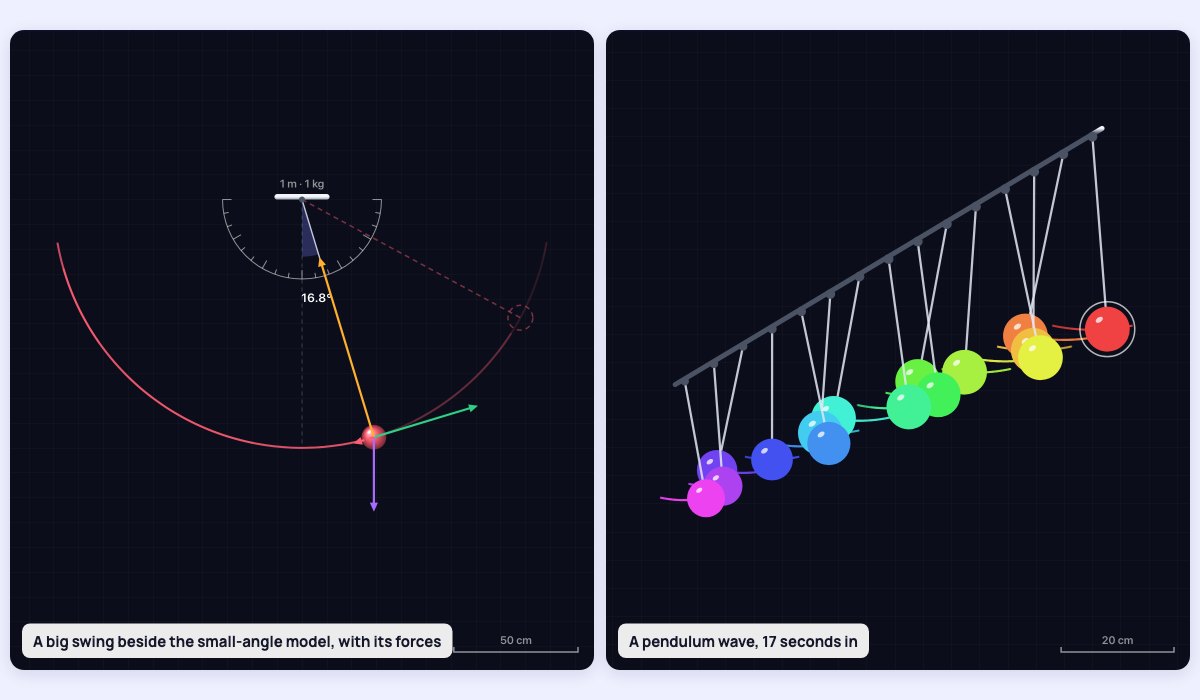
Pendulums of lengths chosen so that, in one cycle, the longest swings a whole number of times and each one after it once more. They drift apart into waves and come back in line at the end of the cycle.
The angle from hanging straight down, in degrees.
The stopwatch keeps the pendulum’s time, so it stays right in slow motion. Timing ten swings and dividing by ten is how it is done in a school lab; Time swings starts and stops it exactly as the bob passes the bottom.
What is Pendulum Simulator?
Pendulum Simulator is a pendulum lab in your browser. Hang one pendulum or up to thirty, set each one’s length, mass and starting angle, choose the gravity of the Earth, the Moon or another planet, and watch them swing in real time. It measures every period as it happens and sets it beside the textbook formula, draws graphs of the motion and its energy, shows the forces on the bob, and has a Lab that measures many pendulums for you and works out gravity from them.
What it can do
- The exact physics: each pendulum follows θ″ = −(g/L)·sin θ, solved in steps of half a millisecond, so big swings, swings over the top and upside-down balances all come out right.
- The small-angle model beside it: a dashed ghost follows the textbook equation with θ in place of sin θ, so you can see exactly when it stops being true.
- Periods measured and explained: the time of each full swing, next to 2π√(L/g) and to the exact formula for that swing, with frequency, amplitude, speed, energy and the pull of the rod.
- A Lab: change the length, the angle, the mass or gravity in steps, measure each pendulum, plot the period or its square, and get g from the best straight line. Export the table as CSV.
- A stopwatch that counts the swings, the way it is done in a school lab, and keeps the pendulum’s time even in slow motion.
- Drives: a push in rhythm for resonance and chaos, or the pivot shaken sideways or up and down, which can make a pendulum stand on its head.
- 16 variations: a seconds pendulum, a big swing, a quarter of the length, heavy and light, the Moon, bob and rod, a pendulum wave, over the top, upside down, friction, resonance, Kapitza’s pendulum, shaken sideways, chaos and a mystery planet.
- See it clearly: a protractor, velocity and force arrows, trails, a grid and scale, three themes, a tick at each swing, slow motion down to a tenth, pictures, videos and a link that opens your pendulums as they are.
How to use it
- It starts at once with a one-metre pendulum. Drag the bob to any angle and let go; Space pauses it and R starts it again.
- Pick a variation, or change the length, mass, start angle and start push under Pendulums. Add up to eight pendulums to compare, or make a pendulum wave of up to thirty.
- Choose the gravity, friction and how the pivots stand under World, and a push or a shaking pivot under Drive.
- Read the measured period under Measurements, and switch the graph between angle, speed, energy and the phase portrait.
- Open the Lab, choose what to change and over what range, and press Measure. Plot the period squared against length, and the slope of the line gives gravity.
The period of a pendulum
For small swings, the time a simple pendulum takes to swing there and back is T = 2π√(L/g), where L is its length and g the pull of gravity. Only those two matter: not the mass of the bob, and hardly the size of the swing. A pendulum four times as long takes twice as long; on the Moon, with a sixth of the Earth’s gravity, the same pendulum takes about 2.46 times as long. A pendulum 99.4 cm long swings each way in one second, which is why it was the heart of the grandfather clock.
The formula comes from treating sin θ as θ, which is only right for small angles. A real pendulum let go from 15° takes 0.4% longer than it says, one from 80° about 14% longer, and one let go from nearly straight up takes longer and longer the closer it starts to the top. The exact period is 4√(L/g)·K(sin(θ₀/2)), with the complete elliptic integral K; the simulator works it out and shows it next to what it measures, which agrees to many decimal places.
A solid rod swinging from one end is a physical pendulum. Its mass is spread along it, so it swings like a simple pendulum two thirds of its length, and its period is 2π√(2L/3g). Friction from the air makes each swing smaller but, surprisingly, hardly changes how long each one takes.
Experiments to try
- Does mass matter? In the Lab, change the mass from 0.2 to 5 kg: the periods form a flat line.
- Find gravity: measure eight lengths from 20 cm to 2 m, plot the period squared, and read g from the slope. Then choose a mystery planet and find its gravity the same way.
- When does the formula fail? Change the start angle from 5° to 170° and watch the period rise above the formula’s flat line.
- Resonance: push the pendulum at its own frequency with a tiny strength, then a little faster or slower, and compare how wide it swings.
- Stand it on its head: shake the pivot of a short pendulum up and down 40 times a second, start it near the top, and it stays there.
- Pendulum wave: make fifteen pendulums that swing 51 to 65 times a minute and watch them form snakes, split into groups and come back in line.
Frequently asked questions
Is this pendulum simulator free?
Yes. There is nothing to sign up for or install, and it runs entirely in your browser, on a phone as well as a computer. Your pendulums are not uploaded: a shared link carries them inside it.
Why does the mass not change the period?
A heavier bob is pulled down harder by gravity, but it is also harder to get moving, in exactly the same proportion. The two cancel, so every bob on the same length swings in the same time, as Galileo found. The mass changes the energy and the pull on the rod, which the simulator shows, but not the timing.
How do I find g with a pendulum?
Measure the period T of a few different lengths L, with small swings. Since T² = (4π²/g)·L, a graph of T² against L is a straight line through zero with slope 4π²/g, so g = 4π² divided by the slope. The Lab does this for you: with Length chosen and Period² plotted, it draws the best line and gives g. Timing ten swings and dividing by ten, as with the stopwatch, makes a hand measurement more precise.
Why does a big swing take longer?
Far out, the pull back towards the middle grows more slowly than the angle (it grows as sin θ, not θ), so the bob is pulled back less hard than the simple formula assumes and takes longer to return. At small angles the difference is tiny; at 90° the period is 18% longer; let go from straight up, the bob would balance and never come back.
What is the small-angle approximation?
It replaces sin θ by θ in the equation of motion, which turns it into the equation of a perfect oscillator with the period 2π√(L/g) whatever the swing. It is very good below about 10° and is what most textbooks use. Turn on the ghost to see both at once: from 80°, the real pendulum soon falls behind.
What is the phase portrait?
A graph of the angle across and the speed of turning up. A swinging pendulum draws a closed loop, small swings an ellipse; one going round and round draws a wavy line; with friction it spirals in to the middle; and a driven chaotic pendulum never repeats its path.
Who discovered how pendulums work?
Galileo Galilei is said to have noticed, in the 1580s, that a swinging lamp seemed to keep the same time however wide it swung, and later that the time depends on the length. Christiaan Huygens worked out the formula and built the first pendulum clock in 1656, and found that big swings take a little longer. For more pendulums, try the Double Pendulum Simulator, where two arms make chaos, and the Newton's Cradle Simulator, where a row of pendulums trade their swings.