Text Tools
 Image Tools
 PDF Tools
 Social Media Tools
 Security Tools
 Coding Tools
 CSS Tools
 Color Tools
 Miscellaneous Tools
 Add to Chrome
 Add to Firefox

Roll a toothed wheel round a ring and watch the pen draw, layer by layer, like the classic toy. Then save it as a picture or a vector.
The numbers of teeth decide the shape. The ring’s teeth divided by what they share with the wheel’s gives the points; the wheel’s divided the same way gives how many times it goes round before the pen gets back to where it started. Wheels that share little with the ring make dense, many-pointed designs.
What is a Spirograph?
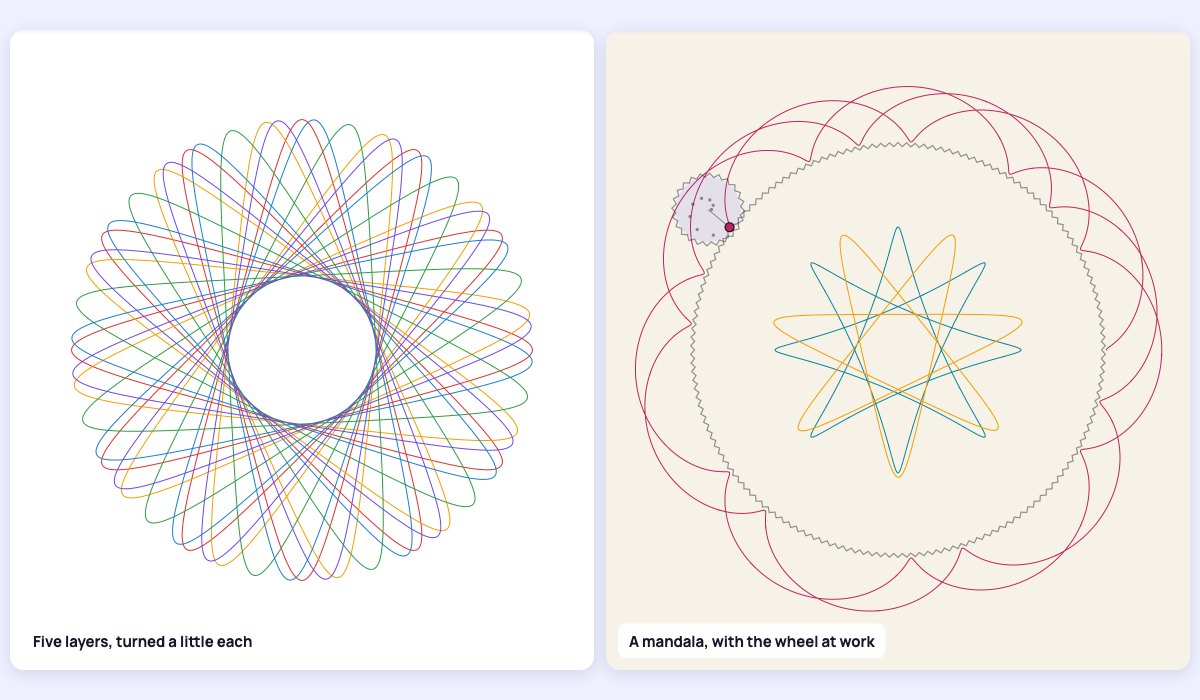
A spirograph is a drawing toy: a plastic wheel with teeth rolls round inside a ring, a pen in one of its holes, and the pen draws a looping, flower-like curve that comes back to where it started. This online version works the same way, with the teeth of the classic set: choose a ring and a wheel, pick the hole for the pen, and watch the wheel turn and the design grow. Add more layers in different pens, turn each a little, and build up a mandala, then save it as a picture, a vector SVG or a video of it being drawn.
What it can do
- Real gears: rings of 96 and 105 teeth to roll inside and 144 and 150 to roll round, and wheels from 24 to 84 teeth, as in the classic set.
- Watch it draw, with the ring, the wheel turning and the pen in its hole, from half a turn to 32 turns a second, or all at once.
- Up to 10 layers, each with its own ring, wheel, hole, angle, pen colour and width, or a rainbow pen.
- Numbers: how many points a design has and how many times the wheel goes round before it closes.
- 10 variations, from the classic flower to a five-point star, lace, a galaxy of 105 points and a neon bloom on dark paper.
- Save it as a PNG of 1080, 2048 or 4096 pixels, a vector SVG for a plotter or a poster, a video, or a link that draws it again.
How to use it
- It starts drawing at once. Pause it, start again or draw it all at once with the buttons under the drawing.
- Choose the ring and the wheel, and whether the wheel rolls inside the ring or round its outside.
- Move the pen hole: near the middle of the wheel for soft loops, near its edge for sharp points.
- Add a layer, turn it a few degrees and give it another pen, and build up the design.
- Pick a variation to start from, change the paper under Look, and save the finished design.
The mathematics of a spirograph
A point on a wheel of radius r rolling inside a ring of radius R traces a hypotrochoid: x = (R − r)·cos t + d·cos((R − r)/r · t), y = (R − r)·sin t − d·sin((R − r)/r · t), where d is how far the pen is from the wheel’s centre. Rolling round the outside, it traces an epitrochoid. Because the teeth fit together, the radii go with the numbers of teeth, and those numbers decide the shape.
Divide both numbers by what they have in common: what is left of the ring’s teeth is the number of points, and what is left of the wheel’s is how many times it goes round before the pen gets home. A 52-tooth wheel in a 96 ring shares 4, so it draws 24 points in 13 turns; a 63 in a 105 shares 21, so it draws a five-point star in 3 turns; a 32 in a 105 shares nothing, so it needs 105 points and 32 turns.
Ideas to try
- Same wheel, every hole: draw it three times with the pen at 30%, 60% and 90% out, in three pens.
- Turn and repeat: add five layers of one design, each turned 8° further, for a moiré of colour.
- Inside and out: put a design round the outside of the ring around one drawn inside it.
- Find a star: look for a wheel whose teeth go into the ring’s with few left over, such as 63 or 42 in the 105 ring.
- Glow on dark paper with a rainbow pen for something that looks like neon.
Frequently asked questions
Is this spirograph online free?
Yes. There is nothing to sign up for or install, it runs in your browser on a phone as well as a computer, and what you save is yours to use, print or sell.
Who invented the spirograph?
The British engineer Denys Fisher developed the toy in the 1960s, and it went on sale in 1965, becoming one of the best-selling toys of its time. The curves themselves are much older: mathematicians studied hypotrochoids and epitrochoids centuries before, and machines drew them for banknote engraving. Spirograph is a trademark of its owner, and this tool is not connected with it.
How is it different from a harmonograph?
A spirograph’s gears make curves that always close exactly, with sharp, regular symmetry. A harmonograph uses swinging pendulums that slowly lose their swing, so its curves spiral inward and never quite repeat. Try both: the Harmonograph is in the tabs above.