Text Tools
 Image Tools
 PDF Tools
 Social Media Tools
 Security Tools
 Coding Tools
 CSS Tools
 Color Tools
 Miscellaneous Tools
 Add to Chrome
 Add to Firefox


Enter or scan your 2x2 cube and get the shortest solution, 11 moves or fewer, shown move by move in 3D.
Hold the cube any way you like and keep it that way: a 2×2 has no fixed centres, so any side can be the top. Pick a colour (keys 1 to 6), then tap or drag over the squares. The side faces are as you see them when you turn the cube left; the top with the front at the bottom, the bottom with the front at the top.
24 squares have no colour yet.
What is the 2x2 Rubik's Cube Solver?
The 2x2 Rubik's Cube Solver takes the colours of a mixed-up 2x2 cube and gives back the shortest solution that exists for it. Not a short one, the shortest: there is no way to solve your cube in fewer turns than the list you get. For any 2x2 that is 11 moves or fewer, and for most cubes it is 8 or 9.
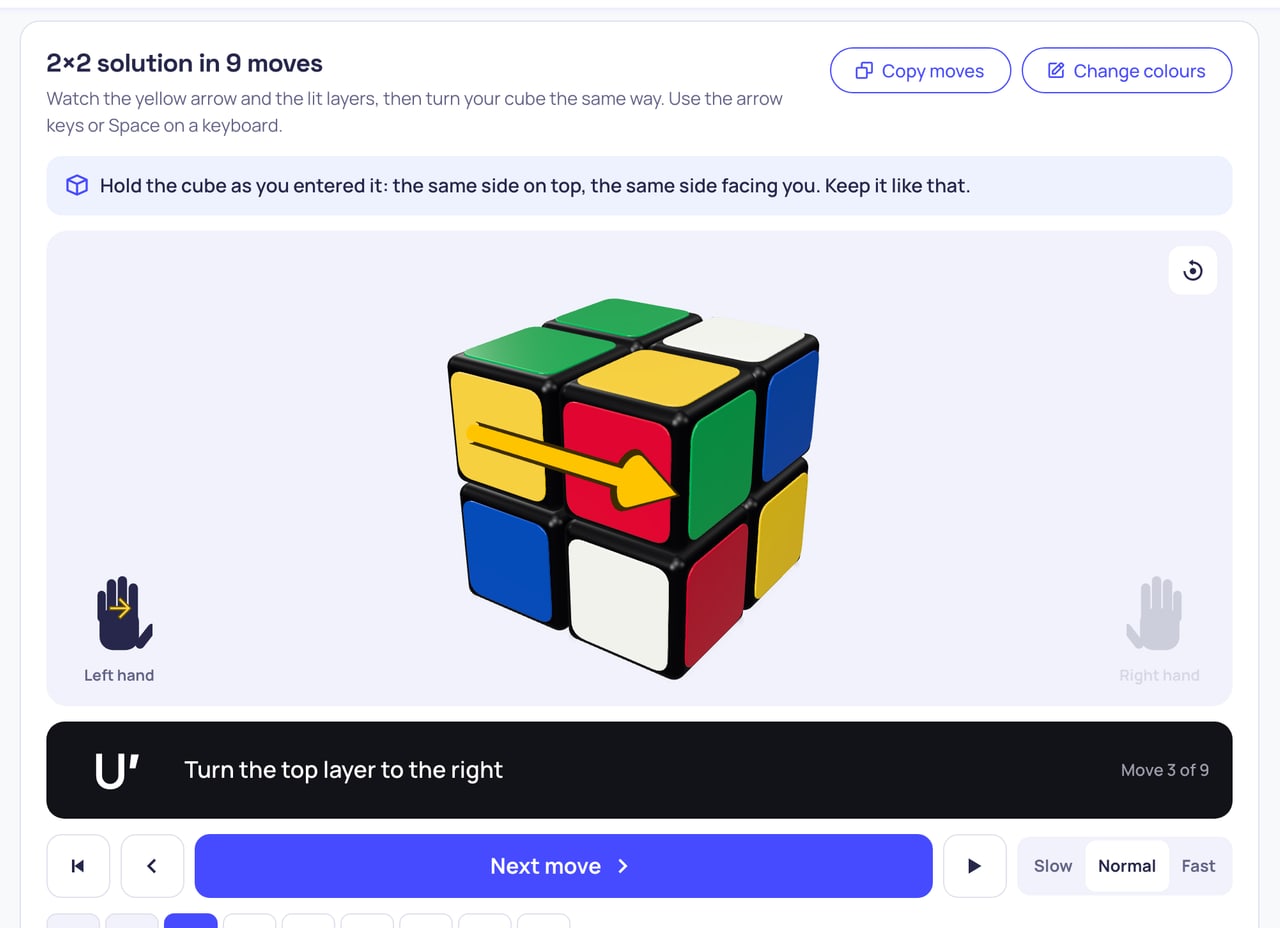
You then follow the moves on a 3D cube that turns the way yours will. The side to turn lights up, a yellow arrow shows the direction, and the move is written out in words next to its letter, so you do not need to know cube notation to use it. Step forward one move at a time, go back if you slip, or press play and watch the whole 2x2 solve itself. Nothing is installed and nothing is uploaded: the 2x2 solver runs in your browser, on a phone as well as on a computer.
How to use the 2x2 cube solver
Hold your 2x2 any way you like. A 2x2 has no centre pieces, so no side is "the white side" until the cube is solved, and the solver does not ask you to find one. Just keep the cube the same way round from the moment you start entering it until the last move.
Under Enter colours you see the cube opened flat: the side facing you in the middle, the top above it, the bottom below, and the left, right and back sides beside it. Pick a colour and tap the squares that have it. There are only 24 squares, four of each colour, and a counter under every colour tells you how many you have placed. The small 3D cube beside the map shows what you entered, so you can turn it and compare it with the cube in your hand.
Two other ways are quicker for some people. Camera reads the six sides one after another when you hold them up to it, and you can correct any square afterwards. Scramble is for cubers: if you mixed a solved cube with a list of moves from a timer, type the list and the cube is set up for you.
When the colours make a real cube, press Solve. The answer appears at once. Turn your cube as the 3D cube shows, press Next move, and repeat. On a keyboard the right arrow goes forward, the left arrow goes back, and Space plays.
Why the solution is never longer than 11 moves
A 2x2 cube is eight corners and nothing else. Counted with one corner held in place, it has exactly 3,674,160 positions. That sounds like a lot, but for a computer it is small enough to search completely, which is impossible for a 3x3 with its 43 quintillion positions.
Every one of those positions has been worked through by computer. The result is known as God's number for the 2x2: no position needs more than 11 moves when a half turn counts as one move, or 14 when only quarter turns count. Only a few thousand positions need the full 11. The average is a little under nine.
This solver does the same search for your cube. It starts from your position and from the solved cube at the same time and stops where the two meet, which takes a fraction of a second. Because it tries every possibility up to that length, the first answer it finds is also the shortest one.
Only three sides ever turn
Look at the solution and you will see only the letters U, R and F: the top, the right and the front. That is on purpose. The corner at the bottom, back, left is never moved, and the other seven corners are solved around it. Turning the left side of a 2x2 does the same job as turning the right side and then turning the whole cube over, so nothing is lost by leaving three sides alone, and the solution is just as short.
For you it means the cube never changes its grip. The bottom, back, left corner stays in the palm of your left hand from the first move to the last. It also explains how the solver knows which colour belongs where without any centres: the three colours on that fixed corner already sit on the sides where they will end up, and the three opposite colours go on the three opposite sides.
How to solve a 2x2 without the solver
The shortest solution is different for every position, so it cannot be memorised. To solve a 2x2 on your own you need a method, and the easiest one uses three steps. If you can already solve a 3x3, you know all of them: a 2x2 is a 3x3 with the edges and centres taken away.
1. The first layer
Choose a colour, say white, and bring its four corners together on one side so that their side colours match each other in pairs. Most people do this by feel after a few tries. Then turn the cube over so that this layer is at the bottom.
2. Turn the top corners
The four corners on top are in the top layer but most are twisted. Repeat R U R′ U R U2 R′, the sequence cubers call the Sune, turning the top between repeats, until the whole top side is one colour.
3. Put the top corners in place
Find two top corners that already match each other on one side and hold that pair at the back. Then do R′ F R′ B2 R F′ R′ B2 R2. If no two match, do it once from any side and look again. A last turn of the top finishes the cube.
This takes 30 to 40 moves instead of nine, but you will know it by heart in an afternoon. A good way to learn is to solve the first layer yourself and enter what is left into the solver: seeing how few moves the rest really needs teaches you to look ahead.
When the solver says your 2x2 cannot be solved
Every square of a 2x2 belongs to a corner, so a single wrong colour always breaks a corner, and the solver can tell you which one. It checks that there are four squares of each colour, that no corner has the same colour twice or two opposite colours such as white and yellow, that no corner appears twice, and that the colours of each corner run the right way round.
If all of that is right and the cube still cannot be solved, one corner is twisted in place. This happens when a corner is turned by force or when the cube was taken apart and put back without care: only one in three ways of putting a 2x2 together can be solved by turning. Twist one corner a third of a turn and enter the colours again.
FAQ
Is the 2x2 solver free?
Yes. There is no account, no app and no limit on how many cubes you solve.
What is the most moves a 2x2 can need?
Eleven, counting a half turn as one move. Positions that far from solved are rare, so most solutions you get here are shorter.
Do I have to hold the cube with white on top?
No. Hold it any way round. Enter each side as you see it and keep the cube that way while you follow the moves. The solved cube may end with any colour on top.
Does it work for a Pocket Cube, a mini cube or a 2x2 with other colours?
Pocket Cube and mini cube are other names for the 2x2, so yes. A cube with different colours works too if you use each colour of the solver for one of yours, keeping opposite sides opposite: white is opposite yellow, red opposite orange, green opposite blue.
Is there a solver for bigger cubes?
Yes: the 3x3 Rubik's Cube Solver, the 4x4 solver and the 5x5 solver. To time your 2x2 solves, use the Rubik's Cube Timer.