
 Text Tools
 Image Tools
 PDF Tools
 Social Media Tools
 Security Tools
 Coding Tools
 CSS Tools
 Color Tools
 Miscellaneous Tools
 Add to Chrome
 Add to Firefox

Lowercases, hyphenates and folds accents down, so ö becomes o and the slug survives being pasted anywhere.
What is Online URL Slug Generator?
URL Slug Generator is a free online tool for generating URL slugs from blog titles, article titles, product names, etc. or any types of strings. For slugify texts or strings, you can use this tool. Slugs are part of URLs, and their main function is to provide an unique address under a given domain, subdomain or subdirectory. URL (stands for Uniform Resource Locator) is a web address that is used to identify a web page. When a user enters an URL in a browser, the browser sends a request to the server to retrieve the web page. Slug is a component of this address, and it helps us to distinguish between different pages on the same domain or folder.
You can see all components of a URL below in detail.
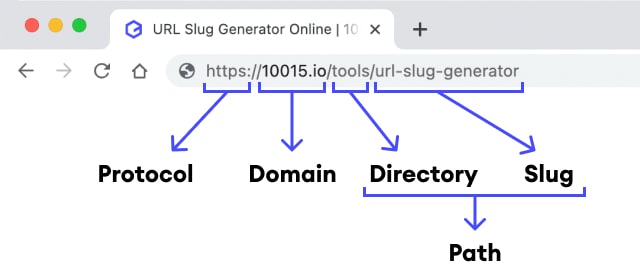
Slugs are not only important for addressing web pages, but they are also used in SEO (Search Engine Optimization) to improve the search engine ranking. It is important to have a SEO-friendly slug for every page on your website. Before then, people are not aware of having a SEO-friendly slug, so they may use unique identifiers, dates or random numbers to address the page. New trend is to slugify the pages by using a title of the page. It also gives information about the page if the URL is used as a link.
For achieving SEO-friendly URL slugs, the advised way is to use a combination of the following components:
- Use lower case letters and numbers only.
- Use dash as a separator
- Remove special characters
There is also a concept called "stop words". Stop words are the most common words in English or any other language which are not the main words but the ones that used like a connector between words. For example, the word "the" is a stop word in English. Some examples for stop words are: "a", "about", "above", "after", "again", "against", "all", "am", "an", "and", "any", "are", "as", "at" ... and so on. Some people prefer the remove stop words in slugs since they are not the key elements of the slug and shorter slugs are better in terms of usage. But some are preferred to keep them in slugs. You can set it according to your preference.
How to use Online URL Slug Generator?
For generating slug from a string, please follow these steps.
- Enter the text in the input field which you want to slugify.
- Default settings is the most common settings. It may work for most users. But if you want to personalize it, you can enable or disable options for using underscore as separator instead of dash, use lower-case and upper-case letters, keep special characters and remove stop words and/or numbers.
- When you enter the title or text, it will slugify it automatically and show the result in the output field. There is no need to click anywhere for triggering the slugification. You can copy the slug to your clipboard by using the copy button.
Frequently asked questions
What makes a good slug?
Short, lowercase, words separated by hyphens, and readable on its own. Someone should be able to look at the URL with the page closed and know roughly what is on it.
Hyphens or underscores?
Hyphens. Search engines treat a hyphen as a word separator and an underscore as a joiner, so my_blog_post reads as one word and my-blog-post reads as three.
What happens to accented and non-English characters?
They are converted to their nearest plain equivalents — ö becomes o, ş becomes s, ı becomes i — so the slug stays readable in a URL bar and in a link somebody pastes into a message.
Should the slug match the page title exactly?
Not necessarily, and usually not. Titles carry filler that a URL does not need. Trimming to the few words that actually identify the page gives you something shorter to type and easier to read.
Can I change a slug after publishing?
You can, but the old URL stops working and anything linking to it breaks unless you redirect. Treat a published slug as close to permanent and spend the extra ten seconds on it up front.
What if I need the whole URL escaped?
That is a different job — the URL Encoder/Decoder escapes reserved characters in a full URL rather than producing a readable slug. Once the URL is settled, the Open Graph Meta Generator controls how it previews when somebody shares it.


