
 Text Tools
 Image Tools
 PDF Tools
 Social Media Tools
 Security Tools
 Coding Tools
 CSS Tools
 Color Tools
 Miscellaneous Tools
 Add to Chrome
 Add to Firefox
128 bits, 32 hex characters, and broken since 2004 — fine for a checksum, unfit for anything an attacker touches.
What is Online MD5 Encrypt/Decrypt?
MD5 Encrypt/Decrypt is a free online tool for generating MD5 hashes from strings and decrypting MD5 hashes to strings. In other words, this tool is a combination of MD5 hash generator and MD5 decrypter. MD5 is a hashing function that creates a unique 128-bit hash with 32 characters long for every string. No matter how long the input string is, it generates a unique output. MD5 stands for "Message-Digest algorithm 5". It is an irreversible function, that means, you can create an MD5 hash with a function directly, but you can't reverse it, in other words, you can't decrypt it with a function.
MD5 is created for cryptographic purposes in 1991. In recent years, SHA256 or SHA512 are used instead of MD5 since it has vulnerabilities and some issues about collusion that means 2 different inputs creates the same hash. Also, with the advances in computer technology and hardware, it becomes easier to crack MD5 hashes. Even MD5 has such vulnerabilities, it is still used widely. One usage purpose is to be used as checksum for data integrity. Most developers still used it in their databases to store sensitive information like passwords or user information, but it can be cracked easily. If the text that is decrypted is a common phrase or a short string, it takes only seconds to decrypt it. If it is a complex one, it may be still cracked with super computers with trial and error.
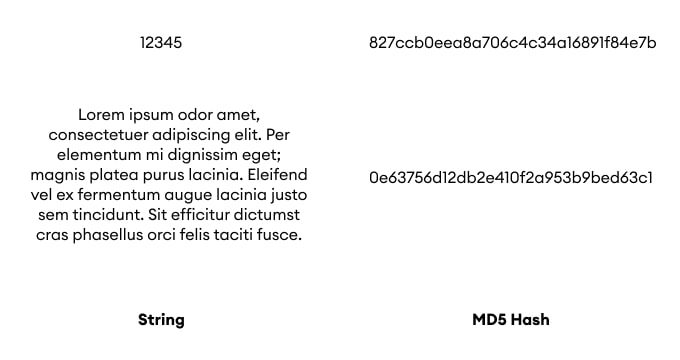
The following image shows how MD5 works; it produces a unique hash with same length for different strings that has different lengths. The origin of the idea is to produce unique hashes, but it is proved that it has collusions which makes it vulnerable.
MD5 is a cryptographic hash function, which means that it is a mathematical algorithm that takes an input of any size and produces a fixed-size output. This output is known as a "hash" and is typically represented as a string of hexadecimal numbers. It is called a "cryptographic" hash function because it has certain properties that make it suitable for use in cryptography.
One of the key properties of a cryptographic hash function is that it is one-way, which means that it is very easy to compute the hash of a given input, but it is extremely difficult to figure out the original input from the hash. This is what makes it useful for ensuring the integrity of data, since even a small change in the input will result in a completely different hash.
Because of this one-way property, it is not possible to "decrypt" an MD5 hash in the traditional sense. You cannot take an MD5 hash and "reverse" it to get the original input. The best you can do is to use a technique known as "hash cracking" to try to determine the original input by guessing possible inputs and then computing the hash of each guess to see if it matches the target hash. This can be a very time-consuming process, especially if the original input was a long and complex password.
As described before, there isn't a function that automatically converts MD5 hash to string. It is impossible to functionally decrypt a MD5 hash. Most popular ways to decrypt MD5 is either to use a database that stores popular hashes with their string equivalents or to use trial and error method. This tool uses both methods. Since MD5 is mostly used to store passwords, it checks most common 100k password for MD5 decryption. If it could not be decrypted, you can use trial and error method by using decryption settings. You have to define character sets and it iterates all possible combinations within these characters to find the related hash. Because of this two-way decryption, this tool is the most advanced online MD5 decrypter you can use.
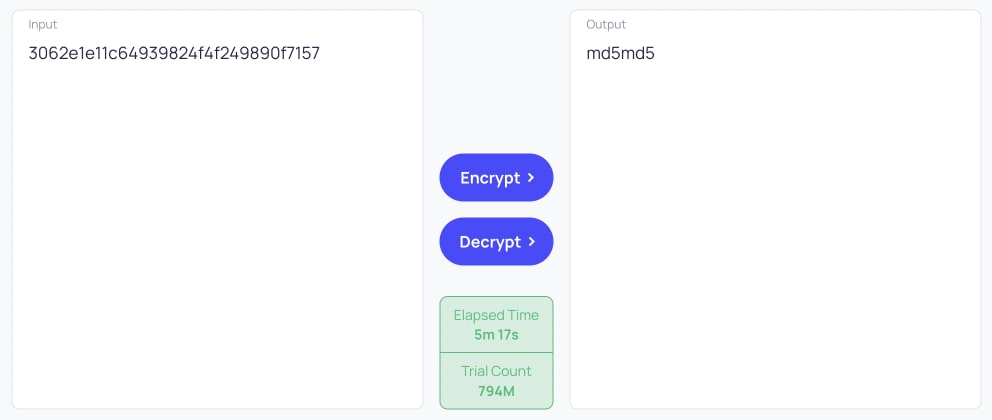
In summary, the process of "decrypting" an MD5 hash involves guessing possible inputs and then computing the hash of each guess to see if it matches the target hash. This can be a very time-consuming process, and it is not always possible to find the original input, especially if it was a long and complex password.
How to use Online MD5 Encrypt/Decrypt?
You can encyrpt or decrypt MD5 by following these steps.
- MD5 encryption is straightforward. Enter the string in input field and click "Encrypt" button.
- For MD5 decryption, enter the MD5 to input field and click "Decrypt". It checks most common 100K passwords as default for decryption. If it does not work, you can extend your search by using "Decryption Settings" button. Here you can include the characters for your trial-and-error iteration.
- Be careful, if you add too many characters for decryption, the time needed for decryption may be long. Be patient and wait for the process.
Some Art
Digital art created by AI is getting more and more popular. Here is a digital art created by AI about decripting MD5 hashes.

Frequently asked questions
What is an MD5 checksum?
An MD5 checksum is the 32-character fingerprint MD5 produces for a file or a piece of text. Run the same input through it twice and you get the same 32 characters; change a single byte and you get something completely different. That is the whole use: a download site publishes the checksum of a file, you hash your copy, and if the two strings match, nothing was corrupted or swapped on the way to you.
How do I check a file against its MD5 checksum?
Compare the two strings character by character — there is no partial match. On a Mac or Linux box md5 file.zip or md5sum file.zip gives you the value; on Windows it is certutil -hashfile file.zip MD5. Paste the published checksum and yours side by side and they either agree or they do not.
Can this reverse a MD5 hash back to the original text?
No, and no tool can. Hashing is deliberately one-way — the output is a fixed 128 bits whatever went in, so the original is not in there to recover. Anything advertising MD5 "decryption" is looking your hash up in a table of already-known values.
Is MD5 safe to use?
Not for anything security-related. Practical collisions — two different inputs producing the same hash — have been demonstrated since 2004 and can now be produced in seconds. It has been unfit for signatures and certificates for twenty years.
Then why is MD5 still everywhere?
Because it is fast and short, and for detecting accidental corruption it still works. A download checksum, a cache key, a quick "did this file change" comparison — none of those involve an adversary, which is the only thing MD5 is bad at.
Can I hash passwords with it?
Absolutely not. MD5 is fast, which is exactly wrong for passwords — speed is what lets an attacker try billions of guesses an hour against a stolen database. Password storage wants bcrypt, scrypt or Argon2, which are deliberately slow.
Why is the output always 32 characters?
Because 128 bits written in hexadecimal is 32 characters, regardless of input. A single letter and a gigabyte file both produce exactly 32.
What should I use instead?
The SHA256 tool for anything where collisions would matter, and the Strong Random Password Generator if you arrived here looking to secure a password.