
 Text Tools
 Image Tools
 PDF Tools
 Social Media Tools
 Security Tools
 Coding Tools
 CSS Tools
 Color Tools
 Miscellaneous Tools
 Add to Chrome
 Add to Firefox


Escapes the characters a URL already uses, so a space becomes %20 and an ampersand stops splitting values.
What is Online URL Encoder/Decoder?
URL Encoder/Decoder is a free online tool for URL encoding and decoding. When you want to escape certain reserved characters in URLs with escape sequences with 1,2 or 3 character lengths, you should encode them. In URL encode, characters like /, ?, +, =, space and comma are converted into character codes. Characters that does not convert are: [A-Za-z] [0-9] - _ . ! ~ * ' ( ). All characters other than that are converted. Here is a table that shows convertion of some characters.
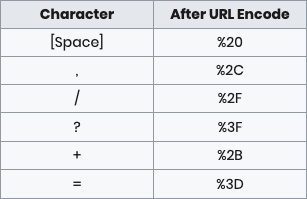
As seen in the table, characters converted into character codes in URLs for escaping. Some characters have semantic importance in URL's such as #, ?, and &. For example, # is used for navigation, ? and & are used for queries. So, if you have a query parameter like '...?search=xxxxx' includes these characters in the xxxxx part in your URL, these has to be escaped to prevent conflicts.
Raw URL: https://google.com
Encoded: https%3A%2F%2Fgoogle.com
How to use Online URL Encoder/Decoder?
You can encode and decode URL by following these steps.
- Enter the URL you want to encode or decode.
- Click the buttons "Encode" or "Decode" according to your input.
- You can copy the encoded or decoded URL by manually or by using the "Copy" button. If you want to reset all inputs and outputs and start from scratch, use "Reset" button.
Frequently asked questions
Which characters have to be escaped?
The ones that already mean something in a URL — / ? # & = + and the space among them. A space becomes %20, a question mark %3F, and so on, so the value is carried rather than interpreted as structure.
Why does a plus sign sometimes mean a space?
Because form submissions use a slightly different encoding from the rest of a URL, where + stands in for a space. It is the classic source of a value arriving with plus signs where the spaces should be.
Do I need to encode the whole URL?
No, and doing so breaks it. The protocol, host and path separators have to stay as they are. Encode the individual values you are putting into a query string, not the string around them.
What is the difference between encodeURI and encodeURIComponent?
Scope. encodeURI leaves the characters that build a URL alone and is for a whole address; encodeURIComponent escapes them too and is for a single parameter value. Using the first where you needed the second is why an ampersand inside a value splits it in half.
Why has my URL come back with %2520 in it?
Double encoding — the % of an existing %20 got escaped to %25. Decode once first, then encode the raw value.
What about HTML and slugs?
The HTML Encoder/Decoder handles markup entities, and the URL Slug Generator makes readable slugs rather than escaping existing ones.


