
 Text Tools
 Image Tools
 PDF Tools
 Social Media Tools
 Security Tools
 Coding Tools
 CSS Tools
 Color Tools
 Miscellaneous Tools
 Add to Chrome
 Add to Firefox
Encodes and decodes in both directions. Base64 is an encoding, not a cipher — it inflates data by a third.
What is Online Base64 Encoder/Decoder?
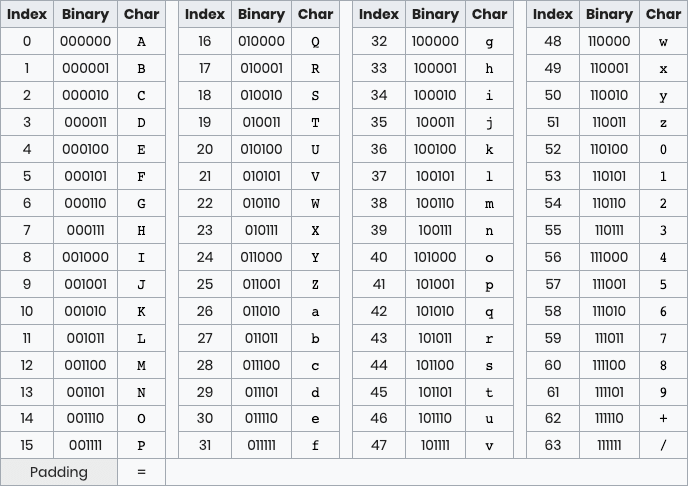
Base64 Encoder/Decoder is a free online tool for encoding string to Base64 or decoding Base64 to string. Base64 is a binary-to-text encoding scheme. You can store data as string with Base64. It's very popular in developer community since you can store data of an image (JPG, PNG or even SVG) as string with Base64. Base64 is also popular since it includes very common 64 characters which are supported almost everywhere. These 64 characters are [A-Z], [a-z], [0-9], "+", "/" and "=". Each Base64 character represents 6-bit binary data. All combinations of 1's and 0's in 6-digit is 2^6 which is 64. There is a character for each combination.
How to use Online Base64 Encoder/Decoder?
You can encode or decode your text by following these steps.
- First, paste your string in the input field. It may be standard text or Base64.
- There are 2 buttons for conversion. One is "Encode" and other is "Decode". If you have a standard text and you want to convert it to Base64, click "Encode" button. If you have a string in Base64 format and want to convert it to standard text, click decode button.
- If you paste an encoded Base64 data and you want to decode it, you may take a warning if the data is somehow malformed or having missing parts.
- You can select the output directly from "Output" area or use "Copy" button to copy the output into your clipboard.
Frequently asked questions
Is Base64 encryption?
No, and it is worth being blunt about it. Base64 is an encoding, not a cipher — anyone can decode it in a second with no key. It hides nothing. Putting a password in Base64 is the same as publishing it.
What is it actually for?
Carrying binary data through channels that only accept text — an image in a data URI, an attachment in an email, a token in a header. It is a transport format, nothing more.
Why does the encoded string get longer?
Because it represents three bytes with four characters, so the output is about a third larger than the input. That is the cost of making arbitrary data safe to put in a text field.
What is URL-safe Base64?
A variant that swaps + and / for - and _, because the standard characters have meaning inside a URL. JWTs use it, which is why a token decoded with plain Base64 sometimes comes back mangled.
Is my data sent to a server?
No. The encoding and decoding both run in the page, so a token or a payload you paste stays on your machine.
What about images and tokens specifically?
The Image to Base64 Converter handles files and gives you ready-made data URIs, and the JWT Encoder/Decoder reads the parts of a token rather than treating it as one string.