
 Text Tools
 Image Tools
 PDF Tools
 Social Media Tools
 Security Tools
 Coding Tools
 CSS Tools
 Color Tools
 Miscellaneous Tools
 Add to Chrome
 Add to Firefox


Removes comments, spacing and the last semicolon in each block. CSS blocks rendering, so the saving lands early.
Minified CSS Code
What is Online CSS Minifier?
CSS Minifier is a free online tool for minifying and compressing CSS code. CSS (Cascading Style Sheets) is a stylesheet language used for defining the display properties of HTML (Hyper Text Markup Language) codes in browsers. All colors, sizes, fonts, alignments, positionings, animations and many different properties of a webpage are defined by CSS.
There are 3 types of CSS; inline, internal or external CSS. Inline CSS is the one which is written directly in an HTML tag. They are generally short and minification is not critical for this type. HTML minification is also handle these types of styles. Internal CSS is the type where you put your styles between <style></style> tags directly in the HTML. This type is a lot longer and it is either handled by CSS Minifiers or HTML minifiers. Third type is external CSS and it is the one where you put your code into a separate file with .css extension. This is the most common way to use CSS in HTML. These files are included to the webpages with a <link> property and it is suggested to add these files to your projects after minified.
It is suggested to use minified/compressed versions of CSS in your webpages. When you minified your CSS, the size will be decreased, and it has a positive impact on page load time and performance. By reducing CSS file size, you can improve user experience by reducing first meaningful paint time.
If you use webpack or other bundlers in your projects, generally they handle these types of minifications. If you make a small webpage without any bundler, you must handle it on your own and you need a CSS minifier/compressor. This tool will work as a CSS compressor and perform these operations automatically for you.
Here is a basic comparison for before and after CSS minification. You can see the size reduction with your bare eyes.
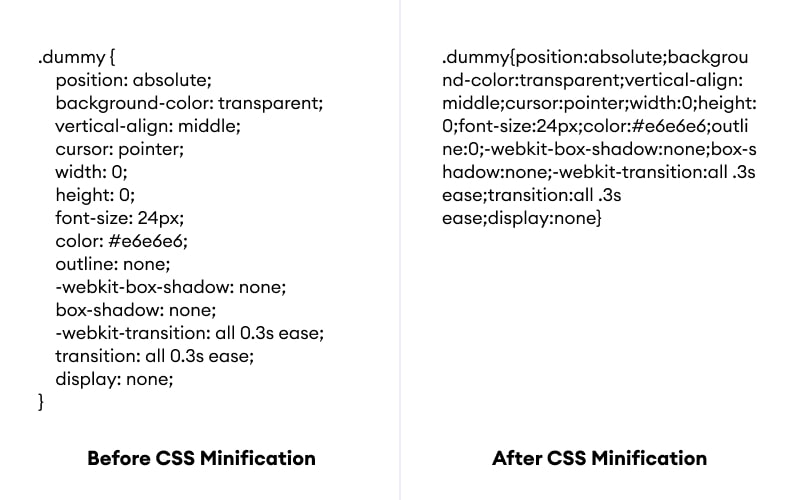
When you compress your CSS code, you will see an info box which shows the estimated percentage for size reduction. It will give you an idea about your performance increase for the time you saved when your file is fetched by the browsers.
How to use Online CSS Minifier?
CSS styles can be minified / compressed by following the steps below.
- Put your CSS styles to the input textbox which you want to minify.
- Click "Minify" button.
- You will see the result in output textbox. If there is a validation error in your CSS and compression is somehow failed, you will see a warning about validation. If your CSS is valid, you can either copy the minified code into your clipboard or download it as style.min.css file.
Frequently asked questions
What gets removed?
Comments, the whitespace around selectors, braces and colons, and the final semicolon before each closing brace. None of it carries meaning to the browser.
How much does it save?
Typically 15-25% on a hand-written stylesheet, more if it was heavily commented. On a file that is already compressed in transit the net gain is smaller, but CSS blocks rendering, so every kilobyte off it is felt earlier than one off a script.
Can minifying break my styles?
Very rarely. CSS has almost no significant whitespace, which makes it the safest of the three to minify. The one thing to watch is a comment used as a hack for an old browser, since those disappear along with the rest.
Does it change my selectors or merge rules?
No. This strips what is unnecessary; it does not rewrite your CSS. Nothing is reordered, nothing is combined, so the cascade behaves exactly as it did.
How do I make it readable again?
The CSS Formatter re-indents a minified stylesheet, which is the quickest way to read someone else's production CSS.
What about unused rules?
Minifying does not find them. Shrinking a stylesheet that is half dead is worth far less than deleting the dead half, and only a tool that can see your markup can tell which half that is.


