 Text Tools
 Image Tools
 PDF Tools
 Social Media Tools
 Security Tools
 Coding Tools
 CSS Tools
 Color Tools
 Miscellaneous Tools
 Add to Chrome
 Add to Firefox

Linear and radial gradients with as many colour stops as you need, previewed as you drag them.
CSSbackground: #474bff;
background: -webkit-linear-gradient(0deg, #474bff 0%, #bc48ff 100%);
background: linear-gradient(0deg, #474bff 0%, #bc48ff 100%);
What is Online CSS Gradient Generator?
CSS Gradient Generator is a free online tool for generating CSS gradients. CSS gradient is a commonly used background type which contains two or more colors which have a color distribution that changes gradually. They are widely used as backgrounds in webpages to provide a fancy effect on design and attract users. If you think that solid backgrounds are boring for your user interface and looking for a lite weight solution, CSS backgrounds is one of the best solutions for this purpose. Image backgrounds has page loading costs and they increase the time needed to load a page. Gradients are a perfect solution if you have concerns on page loading time.
You must be careful when choosing the colors as they have to complete each other. If you need inspiration for colors, you can either use presets or shuffle colors with the button to get random gradients. You can pick if you like any of them and get the code easily.
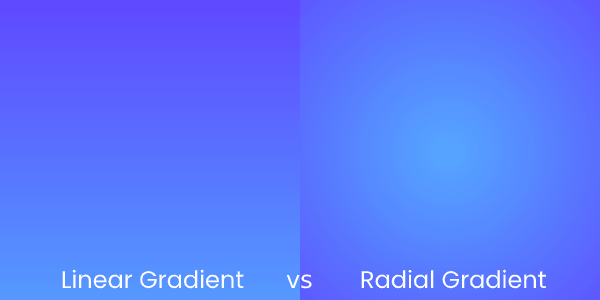
You can generate CSS gradients manually by using up to 3 colors by your own or you may use preset gradients by choosing from the list. There are 2 main gradient type in CSS, one is linear, and one is radial. It identifies the distribution axis of the colors. Here is a basic comparison between linear and radial gradient.
How to use Online CSS Gradient Generator?
You can create your own CSS gradients by following these steps.
- First, set the colors you want to use in your gradient. 2 colors are enabled as default. You can enable 3rd color by checking the "Use 3rd color" checkbox.
- Select the direction of the gradient. You can either choose linear and radial. If you have selected linear, you must send angle of the gradient.
- If you want to use a preset gradient, you can select from the list, and it automatically set colors for you.
- You can copy the CSS code for gradient either manually or by clicking "Copy CSS" button.
Frequently asked questions
Linear or radial — which do I want?
Linear runs along a straight line and suits backgrounds, buttons and overlays. Radial spreads from a point and suits spotlights and glows. Linear is the right default; radial is the one to reach for when something should look lit.
How many colour stops can I use?
As many as you need, though restraint helps. Two or three stops read as a deliberate gradient; a dozen tends to read as a mistake unless you are deliberately after a rainbow.
Why does my gradient look muddy in the middle?
Because the two colours are near-opposite hues and the midpoint between them is grey. Adding a stop in the middle that stays saturated, or picking colours that are closer on the wheel, fixes it.
Can I use a gradient as text colour?
Yes — set it as the background, then clip it to the text with background-clip: text and a transparent text colour. It is widely supported now and a common way to make a heading carry the brand palette. For something louder, the CSS Text Glitch Effect Generator is the other common heading treatment.
Where do I get the colours?
The Image Color Extractor pulls a palette out of a photo, and the Color Tools will generate shades and mix colours from a starting point.