 Text Tools
 Image Tools
 PDF Tools
 Social Media Tools
 Security Tools
 Coding Tools
 CSS Tools
 Color Tools
 Miscellaneous Tools
 Add to Chrome
 Add to Firefox
Three ways to hide a region: pixelate, blur, or a solid bar — only the last one is genuinely unrecoverable.
Drag your image here, or click to browse
Upload a photo before applying censor
Pixel Size: 10px
Found it useful? or .
What is Online Photo Censor?
Photo Censor is a free online tool for censor photos and hide faces in a photo by pixelate or blur the selected region or putting a black stripe in the desired area. Here is 3 different censorship method that is used in image process:
- Pixelate: When an area is selected in a photo, this region will be pixelated, and it will look like a low resolution region. For hiding faces in a photo, just select the face or eyes of a person you want to hide, set the unit width and height of the squares in pixels, and censor the image. Pixelating a photo is the most common way of image censorship.
- Blur: By making a region blurry, you can hide a person's face, but since it is not effective as pixelate, people may still recognize the person whose face is censored. For preventing this, set the strength of blur so that the face become unrecognizable.
- Black Bar: It is the most dominant way of censoring face of a person. Select the region you want to hide in the face. You can select only the eyes or the full face. When you click Censor button, it will hide that region and put a black stripe in the photo instead.
This is a side-by-side comparison between each photo censor type.
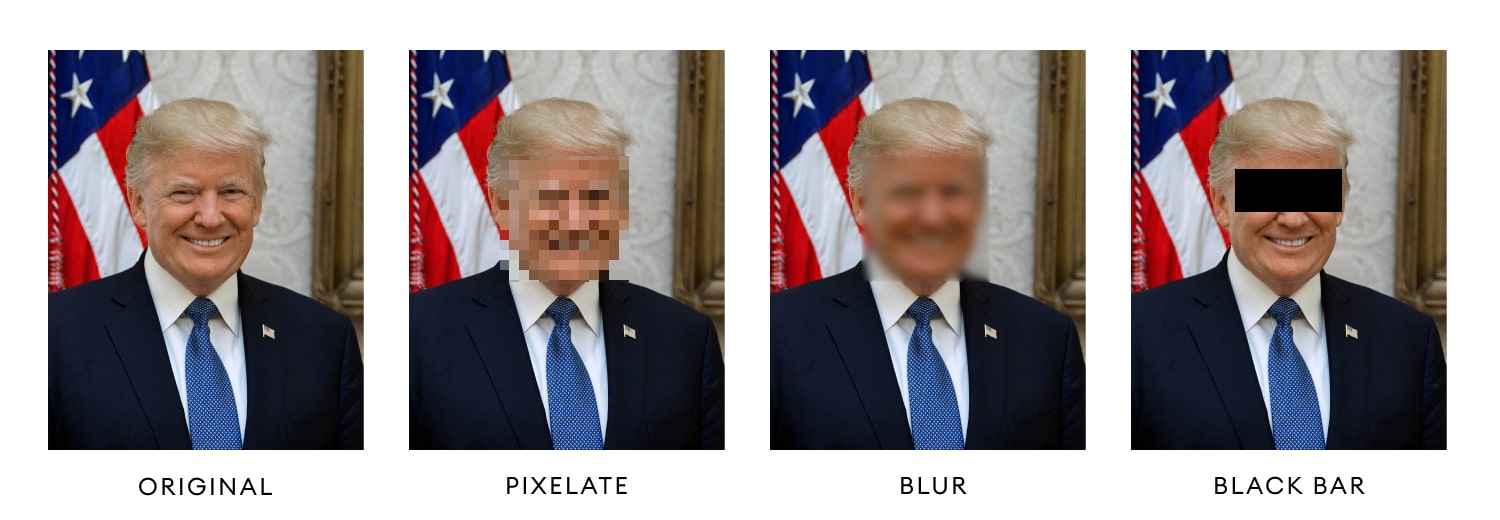
Image Censor Types: Pixelate, Blur & Black Bar
How to use Online Photo Censor?
For censoring faces in photos, you can follow these steps.
- First, select type of image processing method from the list.
- For pixelate and blur, you need to set the amount of the censorship.
- Select the region from the image you want to hide by setting position and size of the area.
- Click the button "Censor" for applying the filter to image. You can download the censored image by using the "Download Image" button.
Frequently asked questions
Which censoring methods are there?
Three — pixelate, blur, and a solid black stripe. Pixelation and a black bar read clearly as deliberate; a light blur can look like a mistake, so pick it only when you want the shape still legible.
Is blurring actually safe?
Be careful here. A heavy blur or a solid bar destroys the information. A light blur or a coarse pixelation sometimes does not, and there are documented cases of faces and text being recovered from weak pixelation. If it genuinely must not be readable, use the black stripe.
Is my photo uploaded anywhere?
No, and that is the point. The whole reason to censor a photo is that something in it is sensitive, so sending it to a server first would be an odd way to start. Everything happens in your browser.
Can I censor more than one area?
Yes. Select each region in turn — several faces in a group photo, a face and a number plate, a name and an address on a screenshot.
Does it work on screenshots of documents?
Yes, and it is a common use. For a PDF rather than an image, bear in mind the same warning applies in reverse — covering text in a PDF hides it visually but leaves it in the file.
What if I want to filter the photo instead of hiding part of it?
The Image Filters apply blur, greyscale and the rest across the whole image rather than to a selected region.
Similar Image Tools
See All